
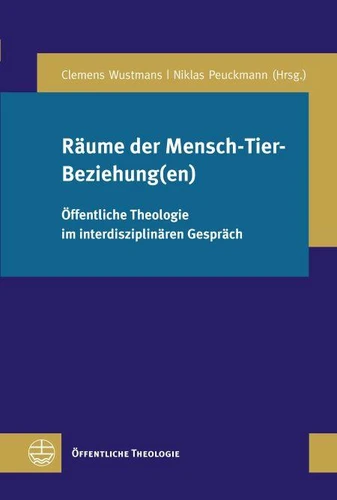
Räume der Mensch-Tier-Beziehung(en). Öffentliche Theologie im interdisziplinären Gespräch
Par : ,Formats :
Disponible dans votre compte client Decitre ou Furet du Nord dès validation de votre commande. Le format PDF est :
- Compatible avec une lecture sur My Vivlio (smartphone, tablette, ordinateur)
- Compatible avec une lecture sur liseuses Vivlio
- Pour les liseuses autres que Vivlio, vous devez utiliser le logiciel Adobe Digital Edition. Non compatible avec la lecture sur les liseuses Kindle, Remarkable et Sony
 , qui est-ce ?
Notre partenaire de plateforme de lecture numérique où vous retrouverez l'ensemble de vos ebooks gratuitement
Pour en savoir plus sur nos ebooks, consultez notre aide en ligne ici
C'est si simple ! Lisez votre ebook avec l'app Vivlio sur votre tablette, mobile ou ordinateur :

- Nombre de pages300
- FormatPDF
- ISBN978-3-374-06447-2
- EAN9783374064472
- Date de parution01/04/2020
- Protection num.Digital Watermarking
- Taille36 Mo
- Infos supplémentairespdf
- ÉditeurEvangelische Verlagsanstalt
Résumé
Ob abstrakt oder konkret, Beziehungen zwischen Mensch und Tier können stets räumlich gefasst werden. Dies reicht vom Zusammenleben in privaten Wohnräumen über zufällige Begegnungen beim Waldspaziergang bis zum Wunsch nach Tiersegnungsgottesdiensten und gemeinsamer Bestattung von Mensch und Tier. Räume der Mensch-Tier-Beziehung sind vielfältig in die Gesellschaft eingezeichnet und prägen diese zutiefst.
Sie sind dabei nicht als statische Gebilde zu verstehen, sondern vielmehr dynamisch veranlagt und von unterschiedlichen Machtasymmetrien durchzogen. Neben evangelisch-, katholisch- und islamisch-theologischen Beiträgen schärfen interdisziplinäre Perspektiven und Orientierungen das Profil des Bandes als Öffentliche Theologie in pluralen, zunehmend kontrovers geführten Gesellschaftsdiskursen. Mit Beiträgen von Janine Eichler, Rainer Hagencord, Simone Horstmann, Martin Huth, Anne Käfer, Miriam Keller, Asmaa El Maaroufi-Ulzheimer, Niklas Peuckmann, Michael Rosenberger, Kirsten Schmidt, Anika Anette Suzan, Kerstin Ternes, Yvonne Sophie Thöne, Jessica Ullrich, Jula Elene Well und Clemens Wustmans. [Spaces of Human-Animal-Relationship(s).
Public Theology and the Interdisciplinary Discourse] Whether abstract or concrete, relationships between humans and animals can always be grasped spatially. The range does include coexistence in private living spaces, accidental encounters during a walk in the forest or the desire for animal blessing services and the joint burial of humans and (their) animals. Spaces of human-animal relationships are marked in society in many ways and are shaping them deeply.
They are not to be understood as static structures, but rather dynamically and traversed by asymmetries of power. In addition to Protestant, Catholic and Islamic theological contributions, interdisciplinary perspectives and orientations sharpen the profile of the volume as a public theology in pluralistic, increasingly controversial public discourses.
Sie sind dabei nicht als statische Gebilde zu verstehen, sondern vielmehr dynamisch veranlagt und von unterschiedlichen Machtasymmetrien durchzogen. Neben evangelisch-, katholisch- und islamisch-theologischen Beiträgen schärfen interdisziplinäre Perspektiven und Orientierungen das Profil des Bandes als Öffentliche Theologie in pluralen, zunehmend kontrovers geführten Gesellschaftsdiskursen. Mit Beiträgen von Janine Eichler, Rainer Hagencord, Simone Horstmann, Martin Huth, Anne Käfer, Miriam Keller, Asmaa El Maaroufi-Ulzheimer, Niklas Peuckmann, Michael Rosenberger, Kirsten Schmidt, Anika Anette Suzan, Kerstin Ternes, Yvonne Sophie Thöne, Jessica Ullrich, Jula Elene Well und Clemens Wustmans. [Spaces of Human-Animal-Relationship(s).
Public Theology and the Interdisciplinary Discourse] Whether abstract or concrete, relationships between humans and animals can always be grasped spatially. The range does include coexistence in private living spaces, accidental encounters during a walk in the forest or the desire for animal blessing services and the joint burial of humans and (their) animals. Spaces of human-animal relationships are marked in society in many ways and are shaping them deeply.
They are not to be understood as static structures, but rather dynamically and traversed by asymmetries of power. In addition to Protestant, Catholic and Islamic theological contributions, interdisciplinary perspectives and orientations sharpen the profile of the volume as a public theology in pluralistic, increasingly controversial public discourses.
