
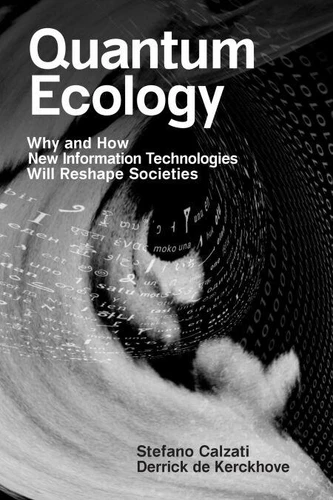
Quantum Ecology. Why and How New Information Technologies Will Reshape Societies
Par : ,Formats :
Disponible dans votre compte client Decitre ou Furet du Nord dès validation de votre commande. Le format ePub protégé est :
- Compatible avec une lecture sur My Vivlio (smartphone, tablette, ordinateur)
- Compatible avec une lecture sur liseuses Vivlio
- Pour les liseuses autres que Vivlio, vous devez utiliser le logiciel Adobe Digital Edition. Non compatible avec la lecture sur les liseuses Kindle, Remarkable et Sony
- Non compatible avec un achat hors France métropolitaine
 , qui est-ce ?
Notre partenaire de plateforme de lecture numérique où vous retrouverez l'ensemble de vos ebooks gratuitement
Pour en savoir plus sur nos ebooks, consultez notre aide en ligne ici
C'est si simple ! Lisez votre ebook avec l'app Vivlio sur votre tablette, mobile ou ordinateur :

- Nombre de pages288
- FormatePub
- ISBN978-0-262-37541-2
- EAN9780262375412
- Date de parution12/11/2024
- Protection num.Adobe DRM
- Taille2 Mo
- Infos supplémentairesepub
- ÉditeurThe MIT Press
Résumé
An exploration of the emerging quantum technological paradigm and its effects on human consciousness and cultures. In Quantum Ecology, Stefano Calzati and Derrick de Kerckhove identify three technological ecologies-linguistic, digital, and quantum-to better understand today's shattered globalized contemporaneity and navigate the impact of soon-to-come quantum information technologies. Today's societies, based as they are on language and writing, face disruption brought on by digital transformation, which is not predicated on sharing meaning but on sheer computability.
This produces what the authors call an "epistemological crisis." From here, the book explores how emerging quantum computers and communication will trigger an even deeper existential shift based on quantum physics' principles of discreteness, uncertainty, and entanglement. Enriched with evidence from biology, anthropology, sociolinguistics, and information and cognitive sciences, the authors draw upon diverse case studies to sustain a convincing philosophical and political argument.
The book's chapters move from a discussion about the coevolution of humans and language to the codependence of writing, thinking, and innovation, then proceed to investigate "datacracy, " the power of algorithms. Finally, the authors outline the looming psychocultural effects and geopolitical challenges of the nascent quantum technological paradigm.
This produces what the authors call an "epistemological crisis." From here, the book explores how emerging quantum computers and communication will trigger an even deeper existential shift based on quantum physics' principles of discreteness, uncertainty, and entanglement. Enriched with evidence from biology, anthropology, sociolinguistics, and information and cognitive sciences, the authors draw upon diverse case studies to sustain a convincing philosophical and political argument.
The book's chapters move from a discussion about the coevolution of humans and language to the codependence of writing, thinking, and innovation, then proceed to investigate "datacracy, " the power of algorithms. Finally, the authors outline the looming psychocultural effects and geopolitical challenges of the nascent quantum technological paradigm.