
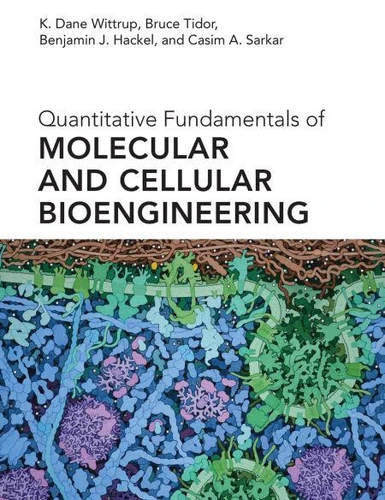
Quantitative Fundamentals of Molecular and Cellular Bioengineering
Par : , , ,Formats :
Disponible dans votre compte client Decitre ou Furet du Nord dès validation de votre commande. Le format ePub protégé est :
- Compatible avec une lecture sur My Vivlio (smartphone, tablette, ordinateur)
- Compatible avec une lecture sur liseuses Vivlio
- Pour les liseuses autres que Vivlio, vous devez utiliser le logiciel Adobe Digital Edition. Non compatible avec la lecture sur les liseuses Kindle, Remarkable et Sony
- Non compatible avec un achat hors France métropolitaine
 , qui est-ce ?
Notre partenaire de plateforme de lecture numérique où vous retrouverez l'ensemble de vos ebooks gratuitement
Pour en savoir plus sur nos ebooks, consultez notre aide en ligne ici
C'est si simple ! Lisez votre ebook avec l'app Vivlio sur votre tablette, mobile ou ordinateur :

- Nombre de pages592
- FormatePub
- ISBN978-0-262-35397-7
- EAN9780262353977
- Date de parution07/01/2020
- Protection num.Adobe DRM
- Taille45 Mo
- Infos supplémentairesepub
- ÉditeurThe MIT Press
Résumé
A comprehensive presentation of essential topics for biological engineers, focusing on the development and application of dynamic models of biomolecular and cellular phenomena. This book describes the fundamental molecular and cellular events responsible for biological function, develops models to study biomolecular and cellular phenomena, and shows, with examples, how models are applied in the design and interpretation of experiments on biological systems.
Integrating molecular cell biology with quantitative engineering analysis and design, it is the first textbook to offer a comprehensive presentation of these essential topics for chemical and biological engineering. The book systematically develops the concepts necessary to understand and study complex biological phenomena, moving from the simplest elements at the smallest scale and progressively adding complexity at the cellular organizational level, focusing on experimental testing of mechanistic hypotheses.
After introducing the motivations for formulation of mathematical rate process models in biology, the text goes on to cover such topics as noncovalent binding interactions; quantitative descriptions of the transient, steady state, and equilibrium interactions of proteins and their ligands; enzyme kinetics; gene expression and protein trafficking; network dynamics; quantitative descriptions of growth dynamics; coupled transport and reaction; and discrete stochastic processes.
The textbook is intended for advanced undergraduate and graduate courses in chemical engineering and bioengineering, and has been developed by the authors for classes they teach at MIT and the University of Minnesota.
Integrating molecular cell biology with quantitative engineering analysis and design, it is the first textbook to offer a comprehensive presentation of these essential topics for chemical and biological engineering. The book systematically develops the concepts necessary to understand and study complex biological phenomena, moving from the simplest elements at the smallest scale and progressively adding complexity at the cellular organizational level, focusing on experimental testing of mechanistic hypotheses.
After introducing the motivations for formulation of mathematical rate process models in biology, the text goes on to cover such topics as noncovalent binding interactions; quantitative descriptions of the transient, steady state, and equilibrium interactions of proteins and their ligands; enzyme kinetics; gene expression and protein trafficking; network dynamics; quantitative descriptions of growth dynamics; coupled transport and reaction; and discrete stochastic processes.
The textbook is intended for advanced undergraduate and graduate courses in chemical engineering and bioengineering, and has been developed by the authors for classes they teach at MIT and the University of Minnesota.