
Nouveauté
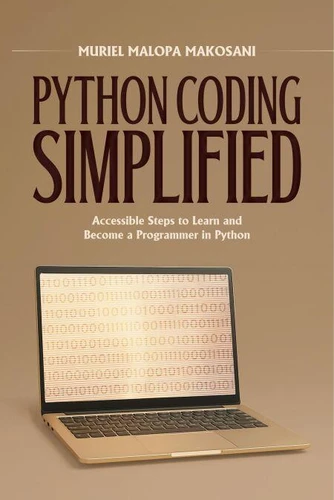
Python Coding Simplified: Accessible Steps to Learn and Become a Programmer in Python
Par :Formats :
Disponible dans votre compte client Decitre ou Furet du Nord dès validation de votre commande. Le format ePub est :
- Compatible avec une lecture sur My Vivlio (smartphone, tablette, ordinateur)
- Compatible avec une lecture sur liseuses Vivlio
- Pour les liseuses autres que Vivlio, vous devez utiliser le logiciel Adobe Digital Edition. Non compatible avec la lecture sur les liseuses Kindle, Remarkable et Sony
 , qui est-ce ?
Notre partenaire de plateforme de lecture numérique où vous retrouverez l'ensemble de vos ebooks gratuitement
Pour en savoir plus sur nos ebooks, consultez notre aide en ligne ici
C'est si simple ! Lisez votre ebook avec l'app Vivlio sur votre tablette, mobile ou ordinateur :

- FormatePub
- ISBN8235216501
- EAN9798235216501
- Date de parution09/07/2026
- Protection num.pas de protection
- Infos supplémentairesepub
- ÉditeurIoakim Ioakim
Résumé
Python Coding Simplified: Accessible Steps to Learn and Become a Programmer in Python is about simplifying the coding intricacies that impede people from learning Python. Assuming no prior knowledge of coding, the book takes a practical , simplified approach, making the fancy Python concepts accessible. The book orients the user to the fundamentals of programming and the behaviour of Python. The user is expected to understand how the machine interprets letters and numbers in such systems as binary and decimal using Python.
They will be taught how to switch numbers between binary and decimal systems. So, they will learn that 1 + 1 = 10, and they are expected to have gained knowledge about Python's simple code that underpins cryptography. Finally, they will take the stairs to the top by taking a first step in becoming a developer through learning Python function. This topic among others teaches an interesting mathematical programming concept known as recursion: a function that instructs itself to run some tasks. Key FeaturesExtensive coding lessons and examples in Python operatorsExtensive coding lessons and examples in Python variablesExtensive coding lessons and examples in Python data typesExtensive coding lessons and examples in Python data structuresExtensive coding lessons and examples in Python function About the AuthorMuriel Malopa Makosani is a PhD economics student at the University of Cape Town (UCT).
She holds a Master's Degree of Economics in Finance (Zhongnan University of Economics and Law). Her passion for programming is natural: she has experiences and earned certificates in Data Science with Python (UCT-GetSmarter), R programming (UCT-DataFirst), Web Design (UCT-GetSmarter), Financial Modelling (UCT-GSB), GIS Spatial Data Science(Esri), GIS Spatial Analytics (Esri) and GIS Modern Geo Apps (Esri).
Her research area of interest focuses on addressing contemporary questions about the risks, returns and future implications of cryptocurrencies.
They will be taught how to switch numbers between binary and decimal systems. So, they will learn that 1 + 1 = 10, and they are expected to have gained knowledge about Python's simple code that underpins cryptography. Finally, they will take the stairs to the top by taking a first step in becoming a developer through learning Python function. This topic among others teaches an interesting mathematical programming concept known as recursion: a function that instructs itself to run some tasks. Key FeaturesExtensive coding lessons and examples in Python operatorsExtensive coding lessons and examples in Python variablesExtensive coding lessons and examples in Python data typesExtensive coding lessons and examples in Python data structuresExtensive coding lessons and examples in Python function About the AuthorMuriel Malopa Makosani is a PhD economics student at the University of Cape Town (UCT).
She holds a Master's Degree of Economics in Finance (Zhongnan University of Economics and Law). Her passion for programming is natural: she has experiences and earned certificates in Data Science with Python (UCT-GetSmarter), R programming (UCT-DataFirst), Web Design (UCT-GetSmarter), Financial Modelling (UCT-GSB), GIS Spatial Data Science(Esri), GIS Spatial Analytics (Esri) and GIS Modern Geo Apps (Esri).
Her research area of interest focuses on addressing contemporary questions about the risks, returns and future implications of cryptocurrencies.