
David Rafferty is Lecturer in Classical Studies at Massey University in New Zealand. His research focuses on Roman political and institutional history under the Republic.
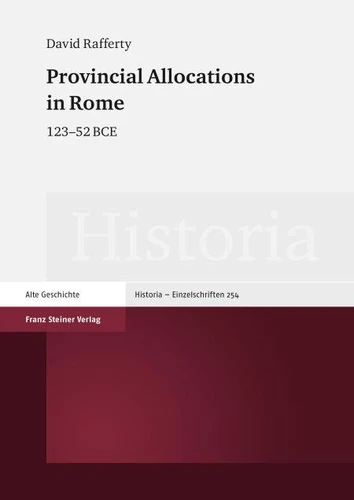
Provincial Allocations in Rome. 123–52 BCE
Par :Formats :
Disponible dans votre compte client Decitre ou Furet du Nord dès validation de votre commande. Le format PDF est :
- Compatible avec une lecture sur My Vivlio (smartphone, tablette, ordinateur)
- Compatible avec une lecture sur liseuses Vivlio
- Pour les liseuses autres que Vivlio, vous devez utiliser le logiciel Adobe Digital Edition. Non compatible avec la lecture sur les liseuses Kindle, Remarkable et Sony
 , qui est-ce ?
Notre partenaire de plateforme de lecture numérique où vous retrouverez l'ensemble de vos ebooks gratuitement
Pour en savoir plus sur nos ebooks, consultez notre aide en ligne ici
C'est si simple ! Lisez votre ebook avec l'app Vivlio sur votre tablette, mobile ou ordinateur :

- Nombre de pages243
- FormatPDF
- ISBN978-3-515-12124-8
- EAN9783515121248
- Date de parution22/02/2019
- Protection num.Digital Watermarking
- Taille1 Mo
- Infos supplémentairespdf
- ÉditeurFranz Steiner
Résumé
This study is the first comprehensive treatment of the provincial allocations system in the late Roman Republic, between the provincial law carried by Gaius Gracchus in 123 BCE and that carried by Pompeius Magnus in 52 BCE. It considers the actual process of allocations, from the Senate's decree of consular and praetorian provinces through to the transfer of command on the ground. Different chapters address the system of allotment (sortitio), the authorisation of troops and funds (ornatio), and the ritual prerequisites for departure, all based solidly on the surviving evidence.
An appendix recording the Senate's year-by-year decisions supports this and allows us to see trends in the data. Since provincial questions were of central importance to the senatorial class, they were the source of many of the political contests which dominate our source record. And at every stage, the institutions shaped the politics. A new picture emerges, of structural conflicts revolving around the relationship between consuls and tribunes.
As Rafferty argues, this made the provincial allocations system one of the central causes of Rome's growing political dysfunction in the late Republic.
An appendix recording the Senate's year-by-year decisions supports this and allows us to see trends in the data. Since provincial questions were of central importance to the senatorial class, they were the source of many of the political contests which dominate our source record. And at every stage, the institutions shaped the politics. A new picture emerges, of structural conflicts revolving around the relationship between consuls and tribunes.
As Rafferty argues, this made the provincial allocations system one of the central causes of Rome's growing political dysfunction in the late Republic.