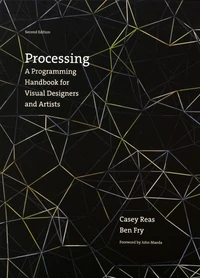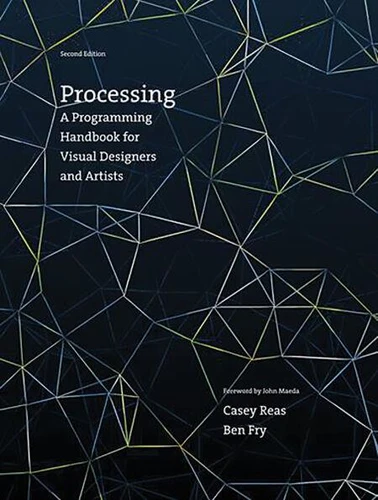
Processing. A Programming Handbook for Visual Designers and Artists
2nd edition
Par : , Formats :
Disponible dans votre compte client Decitre ou Furet du Nord dès validation de votre commande. Le format Epub fixed layout protégé est :
- Compatible avec une lecture sur My Vivlio (smartphone, tablette, ordinateur)
- Compatible avec une lecture sur liseuses Vivlio
- Pour les liseuses autres que Vivlio, vous devez utiliser le logiciel Adobe Digital Edition. Non compatible avec la lecture sur les liseuses Kindle, Remarkable et Sony
- Non compatible avec un achat hors France métropolitaine
 , qui est-ce ?
Notre partenaire de plateforme de lecture numérique où vous retrouverez l'ensemble de vos ebooks gratuitement
Pour en savoir plus sur nos ebooks, consultez notre aide en ligne ici
C'est si simple ! Lisez votre ebook avec l'app Vivlio sur votre tablette, mobile ou ordinateur :

- Nombre de pages662
- FormatEpub fixed layout
- ISBN978-0-262-32186-0
- EAN9780262321860
- Date de parution26/12/2014
- Protection num.Adobe DRM
- Taille52 Mo
- Infos supplémentairesepub
- ÉditeurThe MIT Press
Résumé
The new edition of an introduction to computer programming within the context of the visual arts, using the open-source programming language Processing; thoroughly updated throughout. The visual arts are rapidly changing as media moves into the web, mobile devices, and architecture. When designers and artists learn the basics of writing software, they develop a new form of literacy that enables them to create new media for the present, and to imagine future media that are beyond the capacities of current software tools.
This book introduces this new literacy by teaching computer programming within the context of the visual arts. It offers a comprehensive reference and text for Processing (www.processing.org), an open-source programming language that can be used by students, artists, designers, architects, researchers, and anyone who wants to program images, animation, and interactivity. Written by Processing's cofounders, the book offers a definitive reference for students and professionals.
Tutorial chapters make up the bulk of the book; advanced professional projects from such domains as animation, performance, and installation are discussed in interviews with their creators. This second edition has been thoroughly updated. It is the first book to offer in-depth coverage of Processing 2.0 and 3.0, and all examples have been updated for the new syntax. Every chapter has been revised, and new chapters introduce new ways to work with data and geometry.
New "synthesis" chapters offer discussion and worked examples of such topics as sketching with code, modularity, and algorithms. New interviews have been added that cover a wider range of projects. "Extension" chapters are now offered online so they can be updated to keep pace with technological developments in such fields as computer vision and electronics. InterviewsSUE. C, Larry Cuba, Mark Hansen, Lynn Hershman Leeson, Jürg Lehni, LettError, Golan Levin and Zachary Lieberman, Benjamin Maus, Manfred Mohr, Ash Nehru, Josh On, Bob Sabiston, Jennifer Steinkamp, Jared Tarbell, Steph Thirion, Robert Winter
This book introduces this new literacy by teaching computer programming within the context of the visual arts. It offers a comprehensive reference and text for Processing (www.processing.org), an open-source programming language that can be used by students, artists, designers, architects, researchers, and anyone who wants to program images, animation, and interactivity. Written by Processing's cofounders, the book offers a definitive reference for students and professionals.
Tutorial chapters make up the bulk of the book; advanced professional projects from such domains as animation, performance, and installation are discussed in interviews with their creators. This second edition has been thoroughly updated. It is the first book to offer in-depth coverage of Processing 2.0 and 3.0, and all examples have been updated for the new syntax. Every chapter has been revised, and new chapters introduce new ways to work with data and geometry.
New "synthesis" chapters offer discussion and worked examples of such topics as sketching with code, modularity, and algorithms. New interviews have been added that cover a wider range of projects. "Extension" chapters are now offered online so they can be updated to keep pace with technological developments in such fields as computer vision and electronics. InterviewsSUE. C, Larry Cuba, Mark Hansen, Lynn Hershman Leeson, Jürg Lehni, LettError, Golan Levin and Zachary Lieberman, Benjamin Maus, Manfred Mohr, Ash Nehru, Josh On, Bob Sabiston, Jennifer Steinkamp, Jared Tarbell, Steph Thirion, Robert Winter