
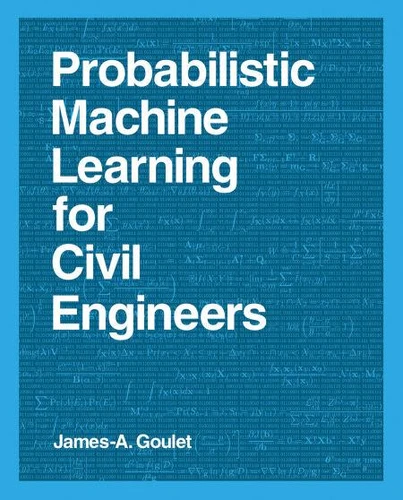
Probabilistic Machine Learning for Civil Engineers
Par :Formats :
Disponible dans votre compte client Decitre ou Furet du Nord dès validation de votre commande. Le format ePub protégé est :
- Compatible avec une lecture sur My Vivlio (smartphone, tablette, ordinateur)
- Compatible avec une lecture sur liseuses Vivlio
- Pour les liseuses autres que Vivlio, vous devez utiliser le logiciel Adobe Digital Edition. Non compatible avec la lecture sur les liseuses Kindle, Remarkable et Sony
- Non compatible avec un achat hors France métropolitaine
 , qui est-ce ?
Notre partenaire de plateforme de lecture numérique où vous retrouverez l'ensemble de vos ebooks gratuitement
Pour en savoir plus sur nos ebooks, consultez notre aide en ligne ici
C'est si simple ! Lisez votre ebook avec l'app Vivlio sur votre tablette, mobile ou ordinateur :

- Nombre de pages304
- FormatePub
- ISBN978-0-262-35801-9
- EAN9780262358019
- Date de parution16/03/2020
- Protection num.Adobe DRM
- Taille13 Mo
- Infos supplémentairesepub
- ÉditeurThe MIT Press
Résumé
An introduction to key concepts and techniques in probabilistic machine learning for civil engineering students and professionals; with many step-by-step examples, illustrations, and exercises. This book introduces probabilistic machine learning concepts to civil engineering students and professionals, presenting key approaches and techniques in a way that is accessible to readers without a specialized background in statistics or computer science.
It presents different methods clearly and directly, through step-by-step examples, illustrations, and exercises. Having mastered the material, readers will be able to understand the more advanced machine learning literature from which this book draws. The book presents key approaches in the three subfields of probabilistic machine learning: supervised learning, unsupervised learning, and reinforcement learning.
It first covers the background knowledge required to understand machine learning, including linear algebra and probability theory. It goes on to present Bayesian estimation, which is behind the formulation of both supervised and unsupervised learning methods, and Markov chain Monte Carlo methods, which enable Bayesian estimation in certain complex cases. The book then covers approaches associated with supervised learning, including regression methods and classification methods, and notions associated with unsupervised learning, including clustering, dimensionality reduction, Bayesian networks, state-space models, and model calibration.
Finally, the book introduces fundamental concepts of rational decisions in uncertain contexts and rational decision-making in uncertain and sequential contexts. Building on this, the book describes the basics of reinforcement learning, whereby a virtual agent learns how to make optimal decisions through trial and error while interacting with its environment.
It presents different methods clearly and directly, through step-by-step examples, illustrations, and exercises. Having mastered the material, readers will be able to understand the more advanced machine learning literature from which this book draws. The book presents key approaches in the three subfields of probabilistic machine learning: supervised learning, unsupervised learning, and reinforcement learning.
It first covers the background knowledge required to understand machine learning, including linear algebra and probability theory. It goes on to present Bayesian estimation, which is behind the formulation of both supervised and unsupervised learning methods, and Markov chain Monte Carlo methods, which enable Bayesian estimation in certain complex cases. The book then covers approaches associated with supervised learning, including regression methods and classification methods, and notions associated with unsupervised learning, including clustering, dimensionality reduction, Bayesian networks, state-space models, and model calibration.
Finally, the book introduces fundamental concepts of rational decisions in uncertain contexts and rational decision-making in uncertain and sequential contexts. Building on this, the book describes the basics of reinforcement learning, whereby a virtual agent learns how to make optimal decisions through trial and error while interacting with its environment.