SOLDES
Jusqu'à -70% sur une sélection d'articles*

Nouveauté
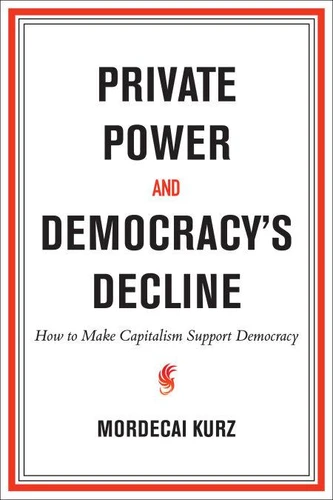
Private Power and Democracy's Decline. How to Make Capitalism Support Democracy
Par :Formats :
Disponible dans votre compte client Decitre ou Furet du Nord dès validation de votre commande. Le format ePub protégé est :
- Compatible avec une lecture sur My Vivlio (smartphone, tablette, ordinateur)
- Compatible avec une lecture sur liseuses Vivlio
- Pour les liseuses autres que Vivlio, vous devez utiliser le logiciel Adobe Digital Edition. Non compatible avec la lecture sur les liseuses Kindle, Remarkable et Sony
- Non compatible avec un achat hors France métropolitaine
 , qui est-ce ?
Notre partenaire de plateforme de lecture numérique où vous retrouverez l'ensemble de vos ebooks gratuitement
Pour en savoir plus sur nos ebooks, consultez notre aide en ligne ici
C'est si simple ! Lisez votre ebook avec l'app Vivlio sur votre tablette, mobile ou ordinateur :

- Nombre de pages326
- FormatePub
- ISBN978-0-262-05354-9
- EAN9780262053549
- Date de parution19/05/2026
- Protection num.Adobe DRM
- Taille764 Ko
- Infos supplémentairesepub
- ÉditeurThe MIT Press
Résumé
Why unregulated free-market capitalism endangers democracy-and what to do about it. In Private Power and Democracy's Decline, Mordecai Kurz explores the relationship between free-market capitalism and democracy. He shows that technology has made capitalism different from what was envisioned in the Age of Enlightenment. Technology creates centers of market power and monopoly concentration that result in a society in which some people are enriched immensely while many workers' livelihoods are often destroyed.
Contrary to conventional thinking, technological competition does not remove market power, which becomes a permanent fixture of free-market capitalism. Such private power creates political inequality and generates forces that cause democracy's decline and possible destruction. Applying these ideas to the US, Kurz shows that today's problems begin in the 1980s with the policy of unregulated free-market capitalism.
Coupled with the information technology revolution, this created a techno-winner-takes-all economy-leading to a second Gilded Age of unsustainable inequality and extreme political polarization. In the last 50 years, the economy "boomed" for some while leaving the majority of America's workers behind. Kurz concludes that only regulated capitalism can support democracy so that the benefits of technology are more equally shared and no person's livelihood is destroyed to enable others to be enriched.
To save democracy, he proposes a "restoration-of-livelihood" policy, offering firms managerial flexibility to maintain rising productivity while ensuring that technology does not destroy the livelihood of others.
Contrary to conventional thinking, technological competition does not remove market power, which becomes a permanent fixture of free-market capitalism. Such private power creates political inequality and generates forces that cause democracy's decline and possible destruction. Applying these ideas to the US, Kurz shows that today's problems begin in the 1980s with the policy of unregulated free-market capitalism.
Coupled with the information technology revolution, this created a techno-winner-takes-all economy-leading to a second Gilded Age of unsustainable inequality and extreme political polarization. In the last 50 years, the economy "boomed" for some while leaving the majority of America's workers behind. Kurz concludes that only regulated capitalism can support democracy so that the benefits of technology are more equally shared and no person's livelihood is destroyed to enable others to be enriched.
To save democracy, he proposes a "restoration-of-livelihood" policy, offering firms managerial flexibility to maintain rising productivity while ensuring that technology does not destroy the livelihood of others.