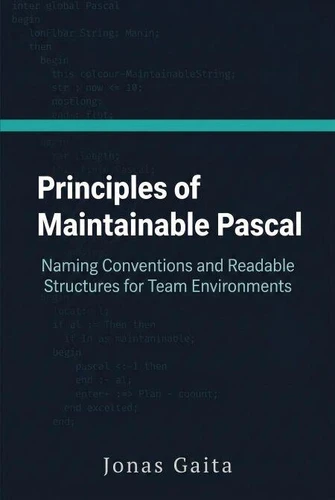
Principles of Maintainable Pascal: Naming Conventions and Readable Structures for Team Environments. Writing Maintainable Pascal
Par :Formats :
Disponible dans votre compte client Decitre ou Furet du Nord dès validation de votre commande. Le format ePub protégé est :
- Compatible avec une lecture sur My Vivlio (smartphone, tablette, ordinateur)
- Compatible avec une lecture sur liseuses Vivlio
- Pour les liseuses autres que Vivlio, vous devez utiliser le logiciel Adobe Digital Edition. Non compatible avec la lecture sur les liseuses Kindle, Remarkable et Sony
- Non compatible avec un achat hors France métropolitaine
 , qui est-ce ?
Notre partenaire de plateforme de lecture numérique où vous retrouverez l'ensemble de vos ebooks gratuitement
Pour en savoir plus sur nos ebooks, consultez notre aide en ligne ici
C'est si simple ! Lisez votre ebook avec l'app Vivlio sur votre tablette, mobile ou ordinateur :

- FormatePub
- ISBN8235286078
- EAN9798235286078
- Date de parution19/03/2026
- Protection num.Adobe DRM
- Infos supplémentairesepub
- ÉditeurIoakim Ioakim
Résumé
Every Pascal developer has opened a legacy codebase and felt that familiar dread. Cryptic variable names. Procedures hundreds of lines long. Units so tangled that fixing one bug breaks three others. This book exists to solve that problem. Principles of Maintainable Pascal is a practical guide for professional developers working with Delphi and Free Pascal in team environments. It delivers a battle-tested framework for writing clean, readable, and scalable code that your entire team can trust, understand, and safely extend for years.
What you will learn: Apply naming conventions that eliminate guesswork and reduce cognitive load instantly Design focused routines and cohesive unit structures built for parallel team workflows Manage memory and resources safely using clear ownership rules and proper exception handling Leverage generics, interfaces, and Pascal's strong type system to catch entire categories of bugs at compile time Refactor legacy codebases using pinning tests and systematic techniques without breaking production Establish code review processes and automated tooling that enforce team standards consistently From naming fundamentals and micro-architecture to OOP design, reliability, and team workflows, every chapter provides concrete, real-world Pascal code examples drawn from genuine enterprise scenarios.
This book is for you if you are a developer transitioning into a collaborative team, a maintainer of a long-running Delphi application, or a team lead building a culture of software craftsmanship. Stop writing code only the compiler understands. Start writing code your team will thank you for.
What you will learn: Apply naming conventions that eliminate guesswork and reduce cognitive load instantly Design focused routines and cohesive unit structures built for parallel team workflows Manage memory and resources safely using clear ownership rules and proper exception handling Leverage generics, interfaces, and Pascal's strong type system to catch entire categories of bugs at compile time Refactor legacy codebases using pinning tests and systematic techniques without breaking production Establish code review processes and automated tooling that enforce team standards consistently From naming fundamentals and micro-architecture to OOP design, reliability, and team workflows, every chapter provides concrete, real-world Pascal code examples drawn from genuine enterprise scenarios.
This book is for you if you are a developer transitioning into a collaborative team, a maintainer of a long-running Delphi application, or a team lead building a culture of software craftsmanship. Stop writing code only the compiler understands. Start writing code your team will thank you for.