SOLDES
Jusqu'à -70% sur une sélection d'articles*

Nouveauté
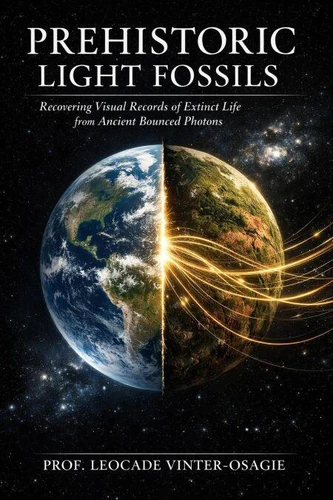
Prehistoric Light Fossils: Recovering Visual Records of Extinct Life from Ancient Bounced Photons
Par :Formats :
Disponible dans votre compte client Decitre ou Furet du Nord dès validation de votre commande. Le format ePub est :
- Compatible avec une lecture sur My Vivlio (smartphone, tablette, ordinateur)
- Compatible avec une lecture sur liseuses Vivlio
- Pour les liseuses autres que Vivlio, vous devez utiliser le logiciel Adobe Digital Edition. Non compatible avec la lecture sur les liseuses Kindle, Remarkable et Sony
 , qui est-ce ?
Notre partenaire de plateforme de lecture numérique où vous retrouverez l'ensemble de vos ebooks gratuitement
Pour en savoir plus sur nos ebooks, consultez notre aide en ligne ici
C'est si simple ! Lisez votre ebook avec l'app Vivlio sur votre tablette, mobile ou ordinateur :

- FormatePub
- ISBN8235092129
- EAN9798235092129
- Date de parution09/06/2026
- Protection num.pas de protection
- Infos supplémentairesepub
- ÉditeurIoakim Ioakim
Résumé
The dinosaurs are not as gone as you think. Every moment those creatures were alive, sunlight was bouncing off their scales and feathers and skin and scattering in all directions into space. Those photons did not stop. They have been traveling at the speed of light for sixty-six million years. Right now, at this moment, the light that last touched a living Tyrannosaurus rex is somewhere in the universe, approximately sixty-six million light-years from Earth, still carrying the precise electromagnetic record of the surface it reflected from.
This is not poetry. This is physics. In Prehistoric Light Fossils, cosmologist and optical physicist Prof. Leocade Vinter-Osagie develops one of the most startling ideas in the history of science: that the universe has been photographing itself since the beginning, that every illuminated surface in the history of Earth has been encoded in photons still traveling through the cosmos, and that these ancient light fossils, though extraordinarily difficult to access, are physically real and in principle recoverable.
Drawing on the established physics of light propagation, quantum optics, information theory, and gravitational lensing, Vinter-Osagie builds the complete scientific framework for what she calls photon paleontology. She shows exactly where the ancient light is, what it carries, why it has survived intact, and what natural concentrating mechanisms in the universe might redirect it toward instruments capable of detecting it.
This is not a book about science fiction. It is a book about what the laws of physics actually permit, and what those permissions reveal about the universe we live in. We are surrounded by the electromagnetic records of every moment of life that has ever existed on this planet. The archive is vast. The photons are real. The question is whether we will ever find a way to read them. Vinter-Osagie guides readers through the physics of photon information preservation, the spectral signatures of Cretaceous vegetation and ocean life, the telescope technologies at the frontier, the mathematical challenge of extracting ancient signals from cosmic noise, and the extraordinary scenario of what we would actually see if prehistoric light fossils were ever recovered: not photographs of individual animals, but the spectral fingerprint of the entire living world they inhabited, including the optical record of the day the asteroid hit.
Sixty-six million years ago, light left this planet carrying a record of everything alive. It is still out there. This book is about finding it.
This is not poetry. This is physics. In Prehistoric Light Fossils, cosmologist and optical physicist Prof. Leocade Vinter-Osagie develops one of the most startling ideas in the history of science: that the universe has been photographing itself since the beginning, that every illuminated surface in the history of Earth has been encoded in photons still traveling through the cosmos, and that these ancient light fossils, though extraordinarily difficult to access, are physically real and in principle recoverable.
Drawing on the established physics of light propagation, quantum optics, information theory, and gravitational lensing, Vinter-Osagie builds the complete scientific framework for what she calls photon paleontology. She shows exactly where the ancient light is, what it carries, why it has survived intact, and what natural concentrating mechanisms in the universe might redirect it toward instruments capable of detecting it.
This is not a book about science fiction. It is a book about what the laws of physics actually permit, and what those permissions reveal about the universe we live in. We are surrounded by the electromagnetic records of every moment of life that has ever existed on this planet. The archive is vast. The photons are real. The question is whether we will ever find a way to read them. Vinter-Osagie guides readers through the physics of photon information preservation, the spectral signatures of Cretaceous vegetation and ocean life, the telescope technologies at the frontier, the mathematical challenge of extracting ancient signals from cosmic noise, and the extraordinary scenario of what we would actually see if prehistoric light fossils were ever recovered: not photographs of individual animals, but the spectral fingerprint of the entire living world they inhabited, including the optical record of the day the asteroid hit.
Sixty-six million years ago, light left this planet carrying a record of everything alive. It is still out there. This book is about finding it.