AI features don't feel magical when you're the one shipping them. They live in cramped UI panels, busy dashboards, and cramped mobile screens - right next to existing flows, constraints, and deadlines.
This book starts from that reality.
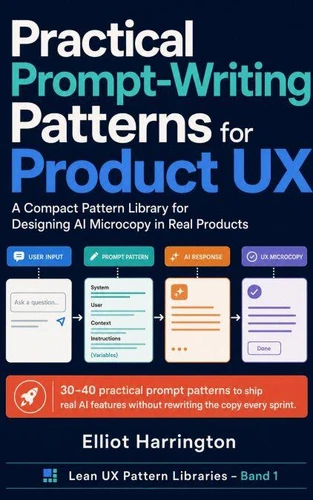
"Practical Prompt-Writing Patterns for Product UX" is a compact, highly usable pattern library for anyone who has to design real AI-assisted product experiences: UX writers, product designers, product managers, and usability teams.
Instead of abstract "prompt engineering" tricks, you get 30-40 reusable, composable patterns for prompt text and AI microcopy - each broken down into:
- Purpose and context: Where the pattern fits in a product flow and what problem it solves.
- Core structure: A simple pattern formula you can adapt quickly (not just a one-off example).
- Worked examples: B2B, consumer, and internal-tool variants to make adaptation easier.
- Tone and length controls: How to keep wording concise, on-brand, and legally safe.
- Usability test checklist: Concrete things to probe in research and A/B tests before launch.
You'll learn how to design prompts and AI-facing microcopy that are stable enough for production, but flexible enough to evolve as your models, policies, and products change.
### What this book helps you do
By the end, you'll be able to:
- Design prompts for real product constraints - limited space, localization, latency, and handoffs between human and AI.
- Control tone, verbosity, and expectations - so users know what the AI can and cannot do, and stakeholders trust the copy in regulated environments.
- Create onboarding for AI features - that builds confidence without overselling capabilities or hiding limitations.
- Handle ambiguity and missing information - with clarification and disambiguation patterns that reduce bad outputs and support quality data collection.
- Write refusal
AI features don't feel magical when you're the one shipping them. They live in cramped UI panels, busy dashboards, and cramped mobile screens - right next to existing flows, constraints, and deadlines.
This book starts from that reality.
"Practical Prompt-Writing Patterns for Product UX" is a compact, highly usable pattern library for anyone who has to design real AI-assisted product experiences: UX writers, product designers, product managers, and usability teams.
Instead of abstract "prompt engineering" tricks, you get 30-40 reusable, composable patterns for prompt text and AI microcopy - each broken down into:
- Purpose and context: Where the pattern fits in a product flow and what problem it solves.
- Core structure: A simple pattern formula you can adapt quickly (not just a one-off example).
- Worked examples: B2B, consumer, and internal-tool variants to make adaptation easier.
- Tone and length controls: How to keep wording concise, on-brand, and legally safe.
- Usability test checklist: Concrete things to probe in research and A/B tests before launch.
You'll learn how to design prompts and AI-facing microcopy that are stable enough for production, but flexible enough to evolve as your models, policies, and products change.
### What this book helps you do
By the end, you'll be able to:
- Design prompts for real product constraints - limited space, localization, latency, and handoffs between human and AI.
- Control tone, verbosity, and expectations - so users know what the AI can and cannot do, and stakeholders trust the copy in regulated environments.
- Create onboarding for AI features - that builds confidence without overselling capabilities or hiding limitations.
- Handle ambiguity and missing information - with clarification and disambiguation patterns that reduce bad outputs and support quality data collection.
- Write refusal