Emma Smith was born and brought up in Leeds, went unexpectedly to university in Oxford, and never really left. She is now Professor of Shakespeare Studies at Hertford College and the author of the Sunday Times bestseller This is Shakespeare. She enjoys silent films, birdwatching, and fast cars.
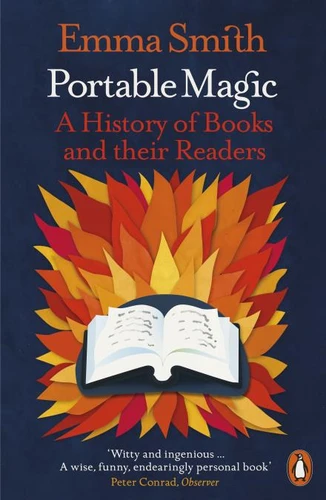
Portable Magic. A History of Books and their Readers
Par :Formats :
Disponible dans votre compte client Decitre ou Furet du Nord dès validation de votre commande. Le format ePub protégé est :
- Compatible avec une lecture sur My Vivlio (smartphone, tablette, ordinateur)
- Compatible avec une lecture sur liseuses Vivlio
- Pour les liseuses autres que Vivlio, vous devez utiliser le logiciel Adobe Digital Edition. Non compatible avec la lecture sur les liseuses Kindle, Remarkable et Sony
- Non compatible avec un achat hors France métropolitaine
 , qui est-ce ?
Notre partenaire de plateforme de lecture numérique où vous retrouverez l'ensemble de vos ebooks gratuitement
Pour en savoir plus sur nos ebooks, consultez notre aide en ligne ici
C'est si simple ! Lisez votre ebook avec l'app Vivlio sur votre tablette, mobile ou ordinateur :

- Nombre de pages352
- FormatePub
- ISBN978-0-241-42728-6
- EAN9780241427286
- Date de parution28/04/2022
- Protection num.Adobe DRM
- Infos supplémentairesepub
- ÉditeurPENGUIN
Résumé
'A fascinating journey into our relationship with the physical book... I lost count of the times I exclaimed with delight when I read a nugget of information I hadn't encountered before' Val McDermid, The TimesMost of what we say about books is really about the words inside them: the rosy nostalgic glow for childhood reading, the lifetime companionship of a much-loved novel. But books are things as well as words, objects in our lives as well as worlds in our heads.
And just as we crack their spines, loosen their leaves and write in their margins, so they disrupt and disorder us in turn. All books are, as Stephen King put it, 'a uniquely portable magic'. Here, Emma Smith shows us why. Portable Magic unfurls an exciting and iconoclastic new story of the book in human hands, exploring when, why and how it acquired its particular hold over us. Gathering together a millennium's worth of pivotal encounters with volumes big and small, Smith reveals that, as much as their contents, it is books' physical form - their 'bookhood' - that lends them their distinctive and sometimes dangerous magic.
From the Diamond Sutra to Jilly Cooper's Riders, to a book made of wrapped slices of cheese, this composite artisanal object has, for centuries, embodied and extended relationships between readers, nations, ideologies and cultures, in significant and unpredictable ways. Exploring the unexpected and unseen consequences of our love affair with books, Portable Magic hails the rise of the mass-market paperback, and dismantles the myth that print began with Gutenberg; it reveals how our reading habits have been shaped by American soldiers, and proposes new definitions of a 'classic'-and even of the book itself.
Ultimately, it illuminates the ways in which our relationship with the written word is more reciprocal - and more turbulent - than we tend to imagine.
And just as we crack their spines, loosen their leaves and write in their margins, so they disrupt and disorder us in turn. All books are, as Stephen King put it, 'a uniquely portable magic'. Here, Emma Smith shows us why. Portable Magic unfurls an exciting and iconoclastic new story of the book in human hands, exploring when, why and how it acquired its particular hold over us. Gathering together a millennium's worth of pivotal encounters with volumes big and small, Smith reveals that, as much as their contents, it is books' physical form - their 'bookhood' - that lends them their distinctive and sometimes dangerous magic.
From the Diamond Sutra to Jilly Cooper's Riders, to a book made of wrapped slices of cheese, this composite artisanal object has, for centuries, embodied and extended relationships between readers, nations, ideologies and cultures, in significant and unpredictable ways. Exploring the unexpected and unseen consequences of our love affair with books, Portable Magic hails the rise of the mass-market paperback, and dismantles the myth that print began with Gutenberg; it reveals how our reading habits have been shaped by American soldiers, and proposes new definitions of a 'classic'-and even of the book itself.
Ultimately, it illuminates the ways in which our relationship with the written word is more reciprocal - and more turbulent - than we tend to imagine.