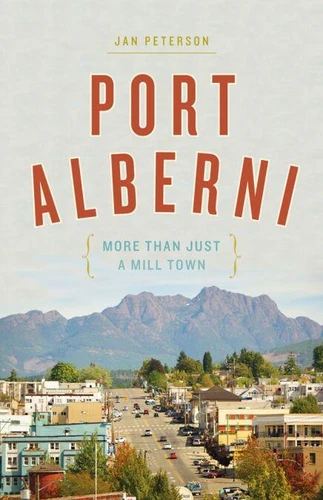
Any community that has ever been labelled a "mill town" carries both the promise of prosperity and the constant threat of collapse, its fortune hinging on a single industry whose performance is as much related to the whims of a global economy as it is to the abundance of a key natural resource. The people of Port Alberni, located deep in Vancouver Island's Alberni Valley, know all too well the highs and lows that come with such a label.
Jan Peterson, who lived in Port Alberni for two of the town's most tumultuous decades and worked as a reporter for the Alberni Valley Times, describes how the town's people persevered through three decades of boom and bust, developed a vibrant arts and sporting community, and strived to make life better under any circumstances. From the prosperous 1970s, when Port Alberni earned the reputation of "forestry capital of Canada, " to the decline of the industry in the 1980s, when economic uncertainty signalled a need for diversification, to the environmental protests in nearby Clayoquot Sound, which polarized the community, Port Alberni tells the town's story from a perspective that is rarely heard.
Through fascinating interviews and meticulous historical research, Peterson captures the heart and soul of a town so often defined by dollars and cents.
Any community that has ever been labelled a "mill town" carries both the promise of prosperity and the constant threat of collapse, its fortune hinging on a single industry whose performance is as much related to the whims of a global economy as it is to the abundance of a key natural resource. The people of Port Alberni, located deep in Vancouver Island's Alberni Valley, know all too well the highs and lows that come with such a label.
Jan Peterson, who lived in Port Alberni for two of the town's most tumultuous decades and worked as a reporter for the Alberni Valley Times, describes how the town's people persevered through three decades of boom and bust, developed a vibrant arts and sporting community, and strived to make life better under any circumstances. From the prosperous 1970s, when Port Alberni earned the reputation of "forestry capital of Canada, " to the decline of the industry in the 1980s, when economic uncertainty signalled a need for diversification, to the environmental protests in nearby Clayoquot Sound, which polarized the community, Port Alberni tells the town's story from a perspective that is rarely heard.
Through fascinating interviews and meticulous historical research, Peterson captures the heart and soul of a town so often defined by dollars and cents.

 , qui est-ce ?
