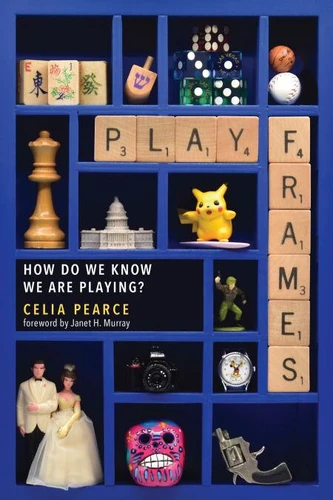
Playframes. How Do We Know We Are Playing?
Par : ,Formats :
Disponible dans votre compte client Decitre ou Furet du Nord dès validation de votre commande. Le format ePub protégé est :
- Compatible avec une lecture sur My Vivlio (smartphone, tablette, ordinateur)
- Compatible avec une lecture sur liseuses Vivlio
- Pour les liseuses autres que Vivlio, vous devez utiliser le logiciel Adobe Digital Edition. Non compatible avec la lecture sur les liseuses Kindle, Remarkable et Sony
- Non compatible avec un achat hors France métropolitaine
 , qui est-ce ?
Notre partenaire de plateforme de lecture numérique où vous retrouverez l'ensemble de vos ebooks gratuitement
Pour en savoir plus sur nos ebooks, consultez notre aide en ligne ici
C'est si simple ! Lisez votre ebook avec l'app Vivlio sur votre tablette, mobile ou ordinateur :

- Nombre de pages338
- FormatePub
- ISBN978-0-262-38122-2
- EAN9780262381222
- Date de parution17/12/2024
- Protection num.Adobe DRM
- Taille2 Mo
- Infos supplémentairesepub
- ÉditeurThe MIT Press
Résumé
An exploration of how we know we're playing and what happens when we don't.2026 Erving Goffman Award for Outstanding Scholarship in the Ecology of Social InteractionPlayframes builds on the work of Gregory Bateson and Erving Goffman to take a deep dive into Bateson's primary question: How do we know we're playing? In this book, Celia Pearce addresses this question by building a comprehensive theory of the specific mechanisms that metacommunicate the message "this is play." This "big tent" approach covers a broad swath of playframes, ranging from theme parks to cosplay, board and video games, and sports, and describes how spatial and temporal frames, as well as artifacts such as costumes and uniforms, toys, and sports equipment, let us know when a play activity is underway.
Pearce teases out distinctions between ritual and play activities, including social practices in which they merge or are indistinguishable, as well as incidents of frame breach or misalignment, where participants' perception of "what is going on" diverges. These principles are illustrated with a series of four topical studies that explore various scenarios in which play and non-play contexts are juxtaposed or blurred.
These span from delightful (fan convention cosplay and simulated and virtual weddings) to confusing (virtual currency and bitcoin) to dangerous. Building on recent research, the book culminates with an in-depth analysis of the gaming roots of the January 6 Capitol insurrection and argues that playframe breach and deliberate misalignment were the major contributing factors.
Pearce teases out distinctions between ritual and play activities, including social practices in which they merge or are indistinguishable, as well as incidents of frame breach or misalignment, where participants' perception of "what is going on" diverges. These principles are illustrated with a series of four topical studies that explore various scenarios in which play and non-play contexts are juxtaposed or blurred.
These span from delightful (fan convention cosplay and simulated and virtual weddings) to confusing (virtual currency and bitcoin) to dangerous. Building on recent research, the book culminates with an in-depth analysis of the gaming roots of the January 6 Capitol insurrection and argues that playframe breach and deliberate misalignment were the major contributing factors.