
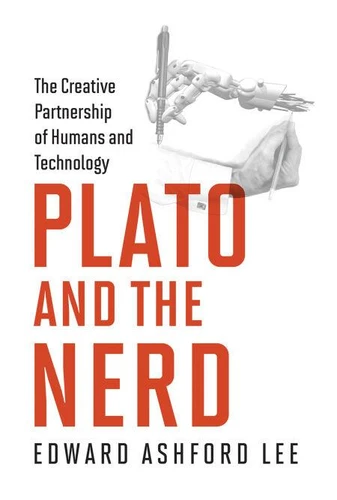
Plato and the Nerd. The Creative Partnership of Humans and Technology
Par :Formats :
Disponible dans votre compte client Decitre ou Furet du Nord dès validation de votre commande. Le format ePub protégé est :
- Compatible avec une lecture sur My Vivlio (smartphone, tablette, ordinateur)
- Compatible avec une lecture sur liseuses Vivlio
- Pour les liseuses autres que Vivlio, vous devez utiliser le logiciel Adobe Digital Edition. Non compatible avec la lecture sur les liseuses Kindle, Remarkable et Sony
- Non compatible avec un achat hors France métropolitaine
 , qui est-ce ?
Notre partenaire de plateforme de lecture numérique où vous retrouverez l'ensemble de vos ebooks gratuitement
Pour en savoir plus sur nos ebooks, consultez notre aide en ligne ici
C'est si simple ! Lisez votre ebook avec l'app Vivlio sur votre tablette, mobile ou ordinateur :

- Nombre de pages288
- FormatePub
- ISBN978-0-262-34121-9
- EAN9780262341219
- Date de parution29/09/2017
- Protection num.Adobe DRM
- Taille12 Mo
- Infos supplémentairesepub
- ÉditeurThe MIT Press
Résumé
How humans and technology evolve together in a creative partnership. In this book, Edward Ashford Lee makes a bold claim: that the creators of digital technology have an unsurpassed medium for creativity. Technology has advanced to the point where progress seems limited not by physical constraints but the human imagination. Writing for both literate technologists and numerate humanists, Lee makes a case for engineering-creating technology-as a deeply intellectual and fundamentally creative process.
Explaining why digital technology has been so transformative and so liberating, Lee argues that the real power of technology stems from its partnership with humans. Lee explores the ways that engineers use models and abstraction to build inventive artificial worlds and to give us things that we never dreamed of-for example, the ability to carry in our pockets everything humans have ever published.
But he also attempts to counter the runaway enthusiasm of some technology boosters who claim everything in the physical world is a computation-that even such complex phenomena as human cognition are software operating on digital data. Lee argues that the evidence for this is weak, and the likelihood that nature has limited itself to processes that conform to today's notion of digital computation is remote.
Lee goes on to argue that artificial intelligence's goal of reproducing human cognitive functions in computers vastly underestimates the potential of computers. In his view, technology is coevolving with humans. It augments our cognitive and physical capabilities while we nurture, develop, and propagate the technology itself. Complementarity is more likely than competition.
Explaining why digital technology has been so transformative and so liberating, Lee argues that the real power of technology stems from its partnership with humans. Lee explores the ways that engineers use models and abstraction to build inventive artificial worlds and to give us things that we never dreamed of-for example, the ability to carry in our pockets everything humans have ever published.
But he also attempts to counter the runaway enthusiasm of some technology boosters who claim everything in the physical world is a computation-that even such complex phenomena as human cognition are software operating on digital data. Lee argues that the evidence for this is weak, and the likelihood that nature has limited itself to processes that conform to today's notion of digital computation is remote.
Lee goes on to argue that artificial intelligence's goal of reproducing human cognitive functions in computers vastly underestimates the potential of computers. In his view, technology is coevolving with humans. It augments our cognitive and physical capabilities while we nurture, develop, and propagate the technology itself. Complementarity is more likely than competition.