
Author
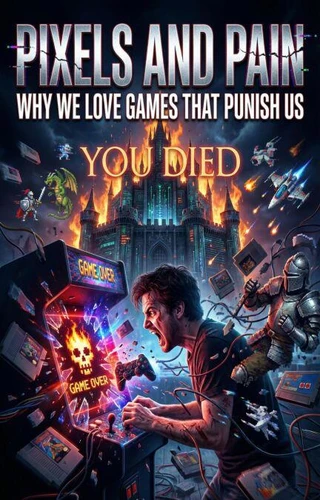
Pixels and Pain. Why We Love Games That Punish Us
Par :Formats :
Disponible dans votre compte client Decitre ou Furet du Nord dès validation de votre commande. Le format ePub est :
- Compatible avec une lecture sur My Vivlio (smartphone, tablette, ordinateur)
- Compatible avec une lecture sur liseuses Vivlio
- Pour les liseuses autres que Vivlio, vous devez utiliser le logiciel Adobe Digital Edition. Non compatible avec la lecture sur les liseuses Kindle, Remarkable et Sony
 , qui est-ce ?
Notre partenaire de plateforme de lecture numérique où vous retrouverez l'ensemble de vos ebooks gratuitement
Pour en savoir plus sur nos ebooks, consultez notre aide en ligne ici
C'est si simple ! Lisez votre ebook avec l'app Vivlio sur votre tablette, mobile ou ordinateur :

- Nombre de pages199
- FormatePub
- ISBN978-3-565-22969-7
- EAN9783565229697
- Date de parution08/02/2026
- Protection num.pas de protection
- Taille920 Ko
- Infos supplémentairesepub
- ÉditeurEmphaloz Publishing House
Résumé
Why do we voluntarily spend hours failing, dying, and restarting? "Pixels and Pain" explores the strange masochism of the hardcore gamer. From the unforgiving coin-munchers of the 80s arcade era to the modern "Soulslike" genre, this book investigates the psychology behind difficulty and reward. It asks a simple question: Is fun really about having a good time, or is it about overcoming suffering?
We trace the evolution of challenge in video games.
In the early days, difficulty was a necessity to extend the life of short games. Today, it is a design philosophy, a badge of honor for players who reject the "hand-holding" of mainstream titles. Through interviews with game designers and competitive players, we uncover the delicate balance between frustration and satisfaction-the "flow state" that only exists on the edge of failure. The book also delves into the culture of speedrunning and eSports, where mastery requires a level of dedication that rivals olympic athletes.
We look at how games simulate the hero's journey, forcing us to grow, learn patterns, and adapt, offering a sense of progression often missing in real life. Whether you are a veteran of the NES era or a modern competitive gamer, this book offers a new perspective on your hobby. It validates the broken controllers and the rage-quits, showing them as essential parts of a medium that tests our limits.
It's a love letter to the "Game Over" screen, and the resilience it teaches us.
In the early days, difficulty was a necessity to extend the life of short games. Today, it is a design philosophy, a badge of honor for players who reject the "hand-holding" of mainstream titles. Through interviews with game designers and competitive players, we uncover the delicate balance between frustration and satisfaction-the "flow state" that only exists on the edge of failure. The book also delves into the culture of speedrunning and eSports, where mastery requires a level of dedication that rivals olympic athletes.
We look at how games simulate the hero's journey, forcing us to grow, learn patterns, and adapt, offering a sense of progression often missing in real life. Whether you are a veteran of the NES era or a modern competitive gamer, this book offers a new perspective on your hobby. It validates the broken controllers and the rage-quits, showing them as essential parts of a medium that tests our limits.
It's a love letter to the "Game Over" screen, and the resilience it teaches us.