SOLDES
Jusqu'à -70% sur une sélection d'articles*

Nouveauté
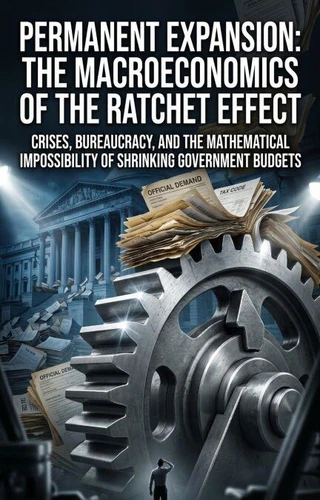
Permanent Expansion: The Macroeconomics of the Ratchet Effect. Crises, Bureaucracy, and the Mathematical Impossibility of Shrinking Government Budgets
Par :Formats :
Disponible dans votre compte client Decitre ou Furet du Nord dès validation de votre commande. Le format ePub est :
- Compatible avec une lecture sur My Vivlio (smartphone, tablette, ordinateur)
- Compatible avec une lecture sur liseuses Vivlio
- Pour les liseuses autres que Vivlio, vous devez utiliser le logiciel Adobe Digital Edition. Non compatible avec la lecture sur les liseuses Kindle, Remarkable et Sony
 , qui est-ce ?
Notre partenaire de plateforme de lecture numérique où vous retrouverez l'ensemble de vos ebooks gratuitement
Pour en savoir plus sur nos ebooks, consultez notre aide en ligne ici
C'est si simple ! Lisez votre ebook avec l'app Vivlio sur votre tablette, mobile ou ordinateur :

- Nombre de pages162
- FormatePub
- ISBN978-3-565-49574-0
- EAN9783565495740
- Date de parution13/06/2026
- Protection num.pas de protection
- Taille710 Ko
- Infos supplémentairesepub
- ÉditeurEmphaloz Publishing House
Résumé
Why is it that during times of war or severe economic crisis, government budgets, emergency taxes, and bureaucratic agencies instantly and massively expand, but when the crisis finally ends, those expenditures almost never shrink back to their original size? This frustrating, unidirectional macroeconomic phenomenon is known as the Ratchet Effect.
Like a mechanical ratchet gear that can only click forward, bureaucratic and economic systems naturally resist contraction.
Once a new government agency is funded or a temporary "emergency" tax is levied, a massive network of lobbyists, employees, and dependent industries forms around it, fiercely fighting to maintain its existence long after its original purpose has vanished. In consumer markets, the Ratchet Effect explains why corporations use temporary supply-chain shocks to raise prices, but conveniently forget to lower them once the logistics normalize, permanently elevating the baseline cost of living. This rigorous economic analysis deconstructs the architecture of institutional bloat.
It explores the history of the income tax, the permanent legacy of wartime economic controls, and the psychological resistance of corporate management to downgrade their own budgets. Understand the mechanics of permanent inflation. The Ratchet Effect proves that in macroeconomics, every "temporary" expansion of power or pricing is almost always a permanent structural shift.
Once a new government agency is funded or a temporary "emergency" tax is levied, a massive network of lobbyists, employees, and dependent industries forms around it, fiercely fighting to maintain its existence long after its original purpose has vanished. In consumer markets, the Ratchet Effect explains why corporations use temporary supply-chain shocks to raise prices, but conveniently forget to lower them once the logistics normalize, permanently elevating the baseline cost of living. This rigorous economic analysis deconstructs the architecture of institutional bloat.
It explores the history of the income tax, the permanent legacy of wartime economic controls, and the psychological resistance of corporate management to downgrade their own budgets. Understand the mechanics of permanent inflation. The Ratchet Effect proves that in macroeconomics, every "temporary" expansion of power or pricing is almost always a permanent structural shift.