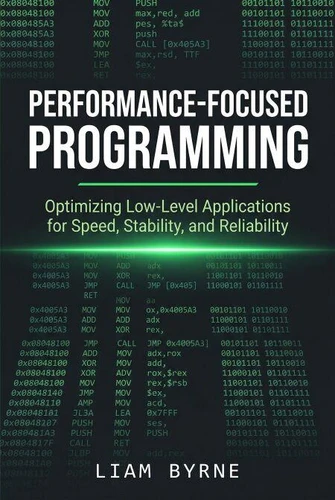
Performance-Focused Programming: Optimizing Low-Level Applications for Speed, Stability, and Reliability. Practical System-Level Software Development, #3
Par :Formats :
Disponible dans votre compte client Decitre ou Furet du Nord dès validation de votre commande. Le format ePub protégé est :
- Compatible avec une lecture sur My Vivlio (smartphone, tablette, ordinateur)
- Compatible avec une lecture sur liseuses Vivlio
- Pour les liseuses autres que Vivlio, vous devez utiliser le logiciel Adobe Digital Edition. Non compatible avec la lecture sur les liseuses Kindle, Remarkable et Sony
- Non compatible avec un achat hors France métropolitaine
 , qui est-ce ?
Notre partenaire de plateforme de lecture numérique où vous retrouverez l'ensemble de vos ebooks gratuitement
Pour en savoir plus sur nos ebooks, consultez notre aide en ligne ici
C'est si simple ! Lisez votre ebook avec l'app Vivlio sur votre tablette, mobile ou ordinateur :

- FormatePub
- ISBN8235284067
- EAN9798235284067
- Date de parution05/04/2026
- Protection num.Adobe DRM
- Infos supplémentairesepub
- ÉditeurIoakim Ioakim
Résumé
Unlock the true speed of your software by mastering the physical machine. Are your backend systems buckling under pressure? When an application must process tens of thousands of requests per second, the hardware is no longer a safety net. It is a strict constraint. Software engineers are often taught to prioritize development speed over execution speed, relying on cloud scaling to mask inefficiencies.
But in low-latency systems, scaling is simply not enough. You need to understand the machine. Performance-Focused Programming is your definitive guide to bridging the gap between high-level software development and low-level physical realities. This comprehensive manual strips away the abstractions of modern programming languages to reveal what the central processing unit is actually doing. You will move beyond vague concepts of optimization and enter the realm of CPU cycles, cache line alignments, instruction-level parallelism, and system call overhead.
What You Will Learn: Hardware Awareness: Master the CPU pipeline, branch prediction, and the memory hierarchy to write code the processor loves to execute. Measuring and Profiling: Stop guessing and start proving. Learn to build sterile benchmarking environments and use industry-standard tools like perf and eBPF. Instruction-Level Optimization: Implement loop unrolling, branchless arithmetic, and Single Instruction Multiple Data vectorization.
Data-Oriented Design: Transition from traditional object-oriented patterns to cache-friendly memory layouts that maximize throughput. Concurrency and Parallelism: Navigate the severe costs of thread context switching, lock contention, and false sharing, while building lock-free data structures. High-Performance I/O: Bypass the operating system kernel with memory-mapped files and direct input output to saturate your network and storage hardware.
Production Reliability: Architect robust systems using backpressure, load shedding, and chaos engineering to guarantee stability under catastrophic load. Whether you are a backend developer transitioning to low-latency microservices or an infrastructure engineer reducing cloud compute costs, this book provides the engineering judgment required to build software that is structurally optimized for speed, stability, and reliability.
Stop letting compiler abstractions hide your performance bottlenecks. Take absolute control of your code.
But in low-latency systems, scaling is simply not enough. You need to understand the machine. Performance-Focused Programming is your definitive guide to bridging the gap between high-level software development and low-level physical realities. This comprehensive manual strips away the abstractions of modern programming languages to reveal what the central processing unit is actually doing. You will move beyond vague concepts of optimization and enter the realm of CPU cycles, cache line alignments, instruction-level parallelism, and system call overhead.
What You Will Learn: Hardware Awareness: Master the CPU pipeline, branch prediction, and the memory hierarchy to write code the processor loves to execute. Measuring and Profiling: Stop guessing and start proving. Learn to build sterile benchmarking environments and use industry-standard tools like perf and eBPF. Instruction-Level Optimization: Implement loop unrolling, branchless arithmetic, and Single Instruction Multiple Data vectorization.
Data-Oriented Design: Transition from traditional object-oriented patterns to cache-friendly memory layouts that maximize throughput. Concurrency and Parallelism: Navigate the severe costs of thread context switching, lock contention, and false sharing, while building lock-free data structures. High-Performance I/O: Bypass the operating system kernel with memory-mapped files and direct input output to saturate your network and storage hardware.
Production Reliability: Architect robust systems using backpressure, load shedding, and chaos engineering to guarantee stability under catastrophic load. Whether you are a backend developer transitioning to low-latency microservices or an infrastructure engineer reducing cloud compute costs, this book provides the engineering judgment required to build software that is structurally optimized for speed, stability, and reliability.
Stop letting compiler abstractions hide your performance bottlenecks. Take absolute control of your code.