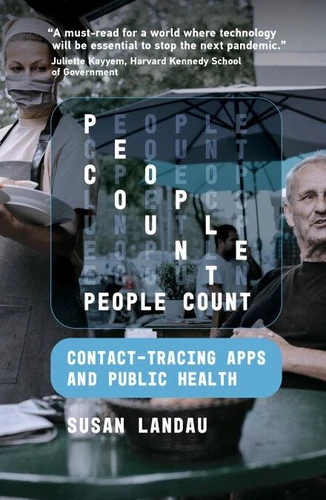
People Count. Contact-Tracing Apps and Public Health
Par :Formats :
Disponible dans votre compte client Decitre ou Furet du Nord dès validation de votre commande. Le format ePub protégé est :
- Compatible avec une lecture sur My Vivlio (smartphone, tablette, ordinateur)
- Compatible avec une lecture sur liseuses Vivlio
- Pour les liseuses autres que Vivlio, vous devez utiliser le logiciel Adobe Digital Edition. Non compatible avec la lecture sur les liseuses Kindle, Remarkable et Sony
- Non compatible avec un achat hors France métropolitaine
 , qui est-ce ?
Notre partenaire de plateforme de lecture numérique où vous retrouverez l'ensemble de vos ebooks gratuitement
Pour en savoir plus sur nos ebooks, consultez notre aide en ligne ici
C'est si simple ! Lisez votre ebook avec l'app Vivlio sur votre tablette, mobile ou ordinateur :

- Nombre de pages184
- FormatePub
- ISBN978-0-262-36381-5
- EAN9780262363815
- Date de parution06/04/2021
- Protection num.Adobe DRM
- Taille263 Ko
- Infos supplémentairesepub
- ÉditeurThe MIT Press
Résumé
An introduction to the technology of contact tracing and its usefulness for public health, considering questions of efficacy, equity, and privacy. How do you stop a pandemic before a vaccine arrives? Contact tracing is key, the first step in a process that has proven effective: trace, test, and isolate. Smartphones can collect some of the information required by contact tracers--not just where you've been but also who's been near you.
Can we repurpose the tracking technology that we carry with us--devices with GPS, Wi-Fi, Bluetooth, and social media connectivity--to serve public health in a pandemic? In People Count, cybersecurity expert Susan Landau looks at some of the apps developed for contact tracing during the COVID-19 pandemic, finding that issues of effectiveness and equity intersect. Landau explains the effectiveness (or ineffectiveness) of a range of technological interventions, including dongles in Singapore that collect proximity information; India's biometric national identity system; Harvard University's experiment, TraceFi; and China's surveillance network.
Other nations rejected China-style surveillance in favor of systems based on Bluetooth, GPS, and cell towers, but Landau explains the limitations of these technologies. She also reports that many current apps appear to be premised on a model of middle-class income and a job that can be done remotely. How can they be effective when low-income communities and front-line workers are the ones who are hit hardest by the virus? COVID-19 will not be our last pandemic; we need to get this essential method of infection control right.
Can we repurpose the tracking technology that we carry with us--devices with GPS, Wi-Fi, Bluetooth, and social media connectivity--to serve public health in a pandemic? In People Count, cybersecurity expert Susan Landau looks at some of the apps developed for contact tracing during the COVID-19 pandemic, finding that issues of effectiveness and equity intersect. Landau explains the effectiveness (or ineffectiveness) of a range of technological interventions, including dongles in Singapore that collect proximity information; India's biometric national identity system; Harvard University's experiment, TraceFi; and China's surveillance network.
Other nations rejected China-style surveillance in favor of systems based on Bluetooth, GPS, and cell towers, but Landau explains the limitations of these technologies. She also reports that many current apps appear to be premised on a model of middle-class income and a job that can be done remotely. How can they be effective when low-income communities and front-line workers are the ones who are hit hardest by the virus? COVID-19 will not be our last pandemic; we need to get this essential method of infection control right.