SOLDES
Jusqu'à -70% sur une sélection d'articles*

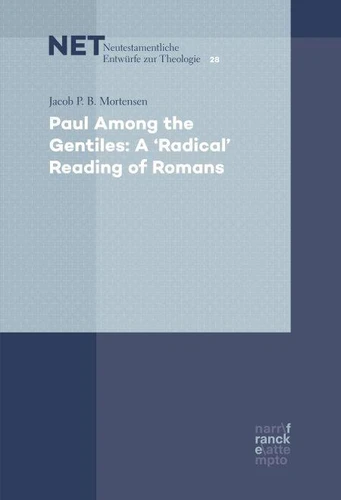
Paul Among the Gentiles: A "Radical" Reading of Romans
Par :Formats :
Disponible dans votre compte client Decitre ou Furet du Nord dès validation de votre commande. Le format ePub est :
- Compatible avec une lecture sur My Vivlio (smartphone, tablette, ordinateur)
- Compatible avec une lecture sur liseuses Vivlio
- Pour les liseuses autres que Vivlio, vous devez utiliser le logiciel Adobe Digital Edition. Non compatible avec la lecture sur les liseuses Kindle, Remarkable et Sony
 , qui est-ce ?
Notre partenaire de plateforme de lecture numérique où vous retrouverez l'ensemble de vos ebooks gratuitement
Pour en savoir plus sur nos ebooks, consultez notre aide en ligne ici
C'est si simple ! Lisez votre ebook avec l'app Vivlio sur votre tablette, mobile ou ordinateur :

- Nombre de pages366
- FormatePub
- ISBN978-3-7720-0075-1
- EAN9783772000751
- Date de parution13/08/2018
- Protection num.Digital Watermarking
- Taille2 Mo
- Infos supplémentairesepub
- ÉditeurFrancke
Résumé
This exciting new interpretation of Paul's Letter to the Romans approaches Paul's most famous letter from one of the newest scholarly positions within Pauline Studies: The Radical New Perspective on Paul (also known as Paul within Judaism). As a point of departure, the author takes Paul's self-designation in 11:13 as "apostle to the gentiles" as so determining for Paul's mission that the audience of the letter is perceived to be exclusively gentile.
The study finds confirmation of this reading-strategy in the letter's construction of the interlocutor from chapter 2 onwards. Even in 2:17, where Paul describes the interlocutor as someone who "calls himself a Jew, " it requests to perceive this person as a gentile who presents himself as a Jew and not an ethnic Jew. If the interlocutor is perceived in this way throughout the letter, the dialogue between Paul and the interlocutor can be perceived as a continuous, unified and developing dialogue.
In this way, this interpretation of Romans sketches out a position against a more disparate and fragmentary interpretation of Romans.
The study finds confirmation of this reading-strategy in the letter's construction of the interlocutor from chapter 2 onwards. Even in 2:17, where Paul describes the interlocutor as someone who "calls himself a Jew, " it requests to perceive this person as a gentile who presents himself as a Jew and not an ethnic Jew. If the interlocutor is perceived in this way throughout the letter, the dialogue between Paul and the interlocutor can be perceived as a continuous, unified and developing dialogue.
In this way, this interpretation of Romans sketches out a position against a more disparate and fragmentary interpretation of Romans.