
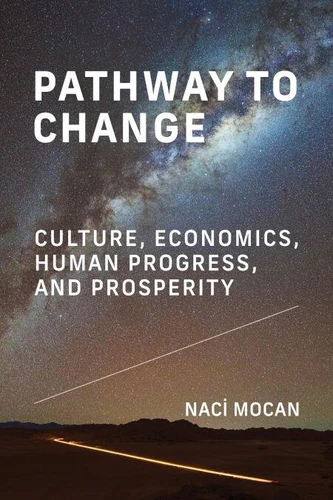
Pathway to Change. Culture, Economics, Human Progress, and Prosperity
Par :Formats :
Disponible dans votre compte client Decitre ou Furet du Nord dès validation de votre commande. Le format ePub protégé est :
- Compatible avec une lecture sur My Vivlio (smartphone, tablette, ordinateur)
- Compatible avec une lecture sur liseuses Vivlio
- Pour les liseuses autres que Vivlio, vous devez utiliser le logiciel Adobe Digital Edition. Non compatible avec la lecture sur les liseuses Kindle, Remarkable et Sony
- Non compatible avec un achat hors France métropolitaine
 , qui est-ce ?
Notre partenaire de plateforme de lecture numérique où vous retrouverez l'ensemble de vos ebooks gratuitement
Pour en savoir plus sur nos ebooks, consultez notre aide en ligne ici
C'est si simple ! Lisez votre ebook avec l'app Vivlio sur votre tablette, mobile ou ordinateur :

- Nombre de pages328
- FormatePub
- ISBN978-0-262-05306-8
- EAN9780262053068
- Date de parution12/05/2026
- Protection num.Adobe DRM
- Taille5 Mo
- Infos supplémentairesepub
- ÉditeurThe MIT Press
Résumé
A fascinating deep dive into the dynamic interplay between culture, economics, institutions, and human prosperity. In Pathway to Change, Naci Mocan investigates the economic origins of current cultural beliefs, attitudes, and behaviors, highlighting the lasting impact of historical agricultural practices and ecological conditions. He shows that cultural traits evolve in response to external shocks-such as exposure to violence, changes in institutional quality, and the laws and law enforcement-and argues that culture and institutions influence each other: culture shapes the functioning of institutions, while institutions also mold cultural norms.
As a result, the success of institutional reforms depends heavily on the cultural context in which they are implemented. Drawing on research from various fields-including economics, evolutionary biology, psychology, linguistics, neuroscience, philosophy, anthropology, and political science-the author describes how cultural attributes such as trust, honesty, patience, preference for leisure, morality, individualism, and proclivity for violence shape economic outcomes and individual well-being.
The book presents evidence on both intergenerational transmission of culture and horizontal transmission within the members of the same generation. It also describes how culture can be shaped and transformed, emphasizing the roles of media, education, laws and law enforcement, and role models. Finally, the book recommends that undesirable cultural attributes that are detrimental to our well-being, determined by scientific criteria, should be modified, and offers policy tools that can be deployed for cultural change.
As a result, the success of institutional reforms depends heavily on the cultural context in which they are implemented. Drawing on research from various fields-including economics, evolutionary biology, psychology, linguistics, neuroscience, philosophy, anthropology, and political science-the author describes how cultural attributes such as trust, honesty, patience, preference for leisure, morality, individualism, and proclivity for violence shape economic outcomes and individual well-being.
The book presents evidence on both intergenerational transmission of culture and horizontal transmission within the members of the same generation. It also describes how culture can be shaped and transformed, emphasizing the roles of media, education, laws and law enforcement, and role models. Finally, the book recommends that undesirable cultural attributes that are detrimental to our well-being, determined by scientific criteria, should be modified, and offers policy tools that can be deployed for cultural change.