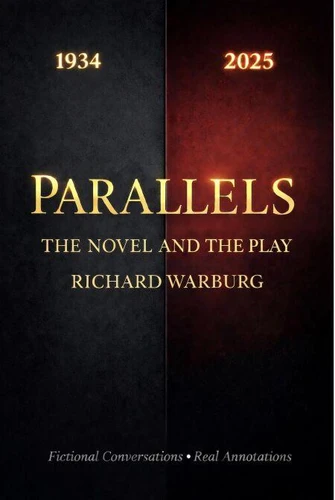
What if a Nazi bureaucrat and an American political operative could speak to each other across time - and found they had more in common than either expected?Parallels is a novel built on a single, chilling device: a piece of recovered Nazi-era technology that enables real-time video communication between 1934 Berlin and present-day Washington. Through a series of conversations, Heinrich, a coordinator in the Reich Ministry of the Interior, and Mark, a senior U.
S. policy advisor, discover that the mechanisms of authoritarian consolidation look remarkably similar across ninety years - emergency powers invoked through manufactured crisis, detention systems built incrementally, courts defied, judges threatened, the press attacked, and dehumanizing language deployed to redefine who belongs and who doesn't. The conversations are fiction. The annotations are not.
Between each chapter of dialogue, documented facts interrupt the narrative: executive orders actually signed, camps actually built, court rulings actually defied, deaths actually recorded. Every annotation is sourced from official records, court filings, government statistics, human rights documentation, and reporting by major news organizations. The fictional frame exists to make the factual record legible - to let readers see the pattern by watching two men from different eras recognize it in each other.
Heinrich is not a fanatic. He's a professional - educated, careful, precise. He loves his family and his country. He does his job without asking unnecessary questions. Mark is not a monster. He's ambitious, certain, and convinced he's saving America from chaos. Neither man believes he is doing anything wrong. That, as the novel's prologue warns, is perhaps the most disturbing part. The novel traces twelve chapters of escalation: from first contact through the transition of power, the judges brought to heel, the camps expanded, the press silenced, the apparatus of enforcement built, and the killings that follow when oversight disappears.
A master comparison table in the appendix documents parallel mechanisms across eleven categories - emergency powers, attacks on the judiciary, detention systems, enforcement apparatus, targeting by category, propaganda, corruption, resistance, and deaths in custody - drawing from both the Nazi consolidation of 1933-1934 and documented American events of 2025-2026. The volume includes the complete novel and a full stage adaptation - a play in two acts designed for a split stage, with Heinrich's 1934 Berlin on one side, Mark's Washington on the other, and a third voice reading the annotations aloud: neither accusing nor excusing, simply stating facts.
A note on methodology makes the author's position explicit: this is not an argument that America is identical to Nazi Germany. It is a documented observation that similar mechanisms appear in both contexts. The Nazis did not begin with death camps. They began with an emergency decree, protective custody, a camp for political prisoners, press restrictions, and dehumanizing language. The question the book poses is not whether history will repeat exactly, but whether we can recognize the patterns while intervention is still possible.
What if a Nazi bureaucrat and an American political operative could speak to each other across time - and found they had more in common than either expected?Parallels is a novel built on a single, chilling device: a piece of recovered Nazi-era technology that enables real-time video communication between 1934 Berlin and present-day Washington. Through a series of conversations, Heinrich, a coordinator in the Reich Ministry of the Interior, and Mark, a senior U.
S. policy advisor, discover that the mechanisms of authoritarian consolidation look remarkably similar across ninety years - emergency powers invoked through manufactured crisis, detention systems built incrementally, courts defied, judges threatened, the press attacked, and dehumanizing language deployed to redefine who belongs and who doesn't. The conversations are fiction. The annotations are not.
Between each chapter of dialogue, documented facts interrupt the narrative: executive orders actually signed, camps actually built, court rulings actually defied, deaths actually recorded. Every annotation is sourced from official records, court filings, government statistics, human rights documentation, and reporting by major news organizations. The fictional frame exists to make the factual record legible - to let readers see the pattern by watching two men from different eras recognize it in each other.
Heinrich is not a fanatic. He's a professional - educated, careful, precise. He loves his family and his country. He does his job without asking unnecessary questions. Mark is not a monster. He's ambitious, certain, and convinced he's saving America from chaos. Neither man believes he is doing anything wrong. That, as the novel's prologue warns, is perhaps the most disturbing part. The novel traces twelve chapters of escalation: from first contact through the transition of power, the judges brought to heel, the camps expanded, the press silenced, the apparatus of enforcement built, and the killings that follow when oversight disappears.
A master comparison table in the appendix documents parallel mechanisms across eleven categories - emergency powers, attacks on the judiciary, detention systems, enforcement apparatus, targeting by category, propaganda, corruption, resistance, and deaths in custody - drawing from both the Nazi consolidation of 1933-1934 and documented American events of 2025-2026. The volume includes the complete novel and a full stage adaptation - a play in two acts designed for a split stage, with Heinrich's 1934 Berlin on one side, Mark's Washington on the other, and a third voice reading the annotations aloud: neither accusing nor excusing, simply stating facts.
A note on methodology makes the author's position explicit: this is not an argument that America is identical to Nazi Germany. It is a documented observation that similar mechanisms appear in both contexts. The Nazis did not begin with death camps. They began with an emergency decree, protective custody, a camp for political prisoners, press restrictions, and dehumanizing language. The question the book poses is not whether history will repeat exactly, but whether we can recognize the patterns while intervention is still possible.


 , qui est-ce ?