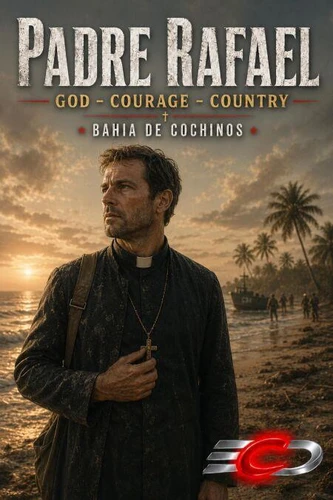
He came to Cuba as a teacher. History asked him to become something else. In 1955, Spanish Escolapian priest Rafael Serrat arrives in Havana to teach history and mathematics at the Escuelas Pías in Santos Suárez. Cuba is supposed to be an assignment. Instead, the school, the neighborhood, and especially the boys in his classroom become part of the life he never expected to claim as his own. Then the Revolution comes.
As political pressure closes around the school and the country Rafael has learned to love changes beyond recognition, students disappear, families flee, and Rafael is eventually forced into exile in Miami. There he discovers that two of his former pupils, Andrés Rodríguez and Tomás Beltrán, have joined Brigade 2506-the Cuban exile force training to return to the island. Rafael taught them that a man must answer for what he believes.
Now those words demand an answer from him. Refusing the safer role of chaplain, Rafael joins the Brigade under the same conditions as the other men. When the Bay of Pigs invasion collapses and escape becomes possible, he makes one more choice: he will not abandon the wounded or the students who once sat in his classroom. Capture is only the beginning. In prison, stripped of freedom and confronted by men determined to understand-or break-him, Rafael returns to the one thing no government can take from him.
He teaches. Set against the real history of Brigade 2506, the Bay of Pigs invasion, and its aftermath, Padre Rafael is a deeply human historical novel about conscience, faith, exile, courage, and the strange ways a teacher's lessons can return to demand something of the teacher himself. Some men are remembered for the battles they fought. Rafael would rather be remembered for the boys he taught.
He came to Cuba as a teacher. History asked him to become something else. In 1955, Spanish Escolapian priest Rafael Serrat arrives in Havana to teach history and mathematics at the Escuelas Pías in Santos Suárez. Cuba is supposed to be an assignment. Instead, the school, the neighborhood, and especially the boys in his classroom become part of the life he never expected to claim as his own. Then the Revolution comes.
As political pressure closes around the school and the country Rafael has learned to love changes beyond recognition, students disappear, families flee, and Rafael is eventually forced into exile in Miami. There he discovers that two of his former pupils, Andrés Rodríguez and Tomás Beltrán, have joined Brigade 2506-the Cuban exile force training to return to the island. Rafael taught them that a man must answer for what he believes.
Now those words demand an answer from him. Refusing the safer role of chaplain, Rafael joins the Brigade under the same conditions as the other men. When the Bay of Pigs invasion collapses and escape becomes possible, he makes one more choice: he will not abandon the wounded or the students who once sat in his classroom. Capture is only the beginning. In prison, stripped of freedom and confronted by men determined to understand-or break-him, Rafael returns to the one thing no government can take from him.
He teaches. Set against the real history of Brigade 2506, the Bay of Pigs invasion, and its aftermath, Padre Rafael is a deeply human historical novel about conscience, faith, exile, courage, and the strange ways a teacher's lessons can return to demand something of the teacher himself. Some men are remembered for the battles they fought. Rafael would rather be remembered for the boys he taught.