Focuses on psychology, emotional resilience, and modern identity in contemporary society.
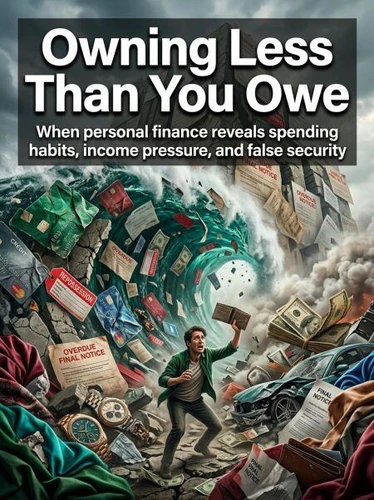
Owning Less Than You Owe. When personal finance reveals spending habits, income pressure, and false security
Par :Formats :
Disponible dans votre compte client Decitre ou Furet du Nord dès validation de votre commande. Le format ePub est :
- Compatible avec une lecture sur My Vivlio (smartphone, tablette, ordinateur)
- Compatible avec une lecture sur liseuses Vivlio
- Pour les liseuses autres que Vivlio, vous devez utiliser le logiciel Adobe Digital Edition. Non compatible avec la lecture sur les liseuses Kindle, Remarkable et Sony
 , qui est-ce ?
Notre partenaire de plateforme de lecture numérique où vous retrouverez l'ensemble de vos ebooks gratuitement
Pour en savoir plus sur nos ebooks, consultez notre aide en ligne ici
C'est si simple ! Lisez votre ebook avec l'app Vivlio sur votre tablette, mobile ou ordinateur :

- Nombre de pages195
- FormatePub
- ISBN978-3-565-48821-6
- EAN9783565488216
- Date de parution09/06/2026
- Protection num.pas de protection
- Taille1 Mo
- Infos supplémentairesepub
- ÉditeurEmphaloz Publishing House
Résumé
Sometimes success looks expensive before it feels safe.
This book enters the emotional gap between looking financially fine and quietly feeling behind. It explores how people confuse possessions with progress, income with control, and credit with freedom. Rather than offering loud formulas, it examines the everyday psychology behind spending habits, personal finance, debt, and financial independence.
Readers will recognize the subtle pull of lifestyle pressure, the relief of buying something now, and the discomfort of asking whether it is an asset or a burden.
With a warm, practical tone, the book reframes money management as a relationship with attention: what comes in, what goes out, what grows, and what silently drains energy. Financial confidence is presented not as perfection, but as the ability to tell the truth sooner. The deeper shift is not about becoming rich overnight. It is about learning to notice what money is doing in real life, so choices begin to feel less borrowed from fear.
With a warm, practical tone, the book reframes money management as a relationship with attention: what comes in, what goes out, what grows, and what silently drains energy. Financial confidence is presented not as perfection, but as the ability to tell the truth sooner. The deeper shift is not about becoming rich overnight. It is about learning to notice what money is doing in real life, so choices begin to feel less borrowed from fear.
A propos de Emma Whitaker


24,99 €

24,99 €