
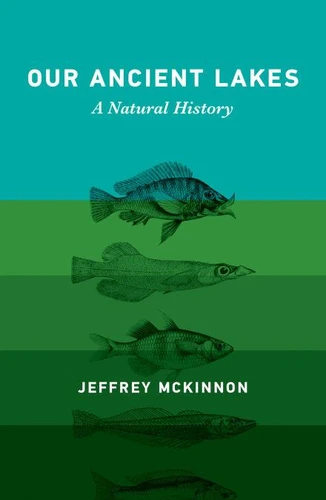
Our Ancient Lakes. A Natural History
Par :Formats :
Disponible dans votre compte client Decitre ou Furet du Nord dès validation de votre commande. Le format ePub protégé est :
- Compatible avec une lecture sur My Vivlio (smartphone, tablette, ordinateur)
- Compatible avec une lecture sur liseuses Vivlio
- Pour les liseuses autres que Vivlio, vous devez utiliser le logiciel Adobe Digital Edition. Non compatible avec la lecture sur les liseuses Kindle, Remarkable et Sony
- Non compatible avec un achat hors France métropolitaine
 , qui est-ce ?
Notre partenaire de plateforme de lecture numérique où vous retrouverez l'ensemble de vos ebooks gratuitement
Pour en savoir plus sur nos ebooks, consultez notre aide en ligne ici
C'est si simple ! Lisez votre ebook avec l'app Vivlio sur votre tablette, mobile ou ordinateur :

- Nombre de pages336
- FormatePub
- ISBN978-0-262-37351-7
- EAN9780262373517
- Date de parution17/10/2023
- Protection num.Adobe DRM
- Taille3 Mo
- Infos supplémentairesepub
- ÉditeurThe MIT Press
Résumé
The unexpected diversity, beauty, and strangeness of life in ancient lakes-some millions of years old-and the remarkable insights the lakes are yielding about the causes of biodiversity. Most lakes are less than 10, 000 years old and short-lived, but there is a much smaller number of ancient lakes, tectonic in origin and often millions of years old, that are scattered across every continent but Antarctica: Baikal, Tanganyika, Victoria, Titicaca, and Biwa, to name a few.
Often these lakes are filled with a diversity of fish, crustaceans, snails, and other creatures found nowhere else in the world. In Our Ancient Lakes, Jeffrey McKinnon introduces the remarkable living diversity of these aquatic bodies to the general reader and explains the surprising, often controversial, findings that the study of their faunas is yielding about the formation and persistence of species. The first single-authored volume to synthesize studies of ancient lakes, Our Ancient Lakes provides an overview of the lakes and their distinctive geological origins; accounts of the evolutionary processes that have generated the incredible diversity found in the lakes and produced some of the fastest speciation rates known for vertebrates; the surprisingly important role of interspecies mating in the most rapid diversifications; the uniquely complete records of the creatures that inhabited the lakes, which are being extracted from deep lake sediments; the prospects for the lakes as we tumble into the Anthropocene; and much more.
Shining a light on a class of biodiversity hot spot that is equivalent to coral reefs in the ocean or tropical rainforests on land, Our Ancient Lakes chronicles in a refreshingly personal and accessible way the often singular wonders of these venerable water bodies. The MIT Press gratefully acknowledges Furthermore: a program of the J. M. Kaplan Fund.
Often these lakes are filled with a diversity of fish, crustaceans, snails, and other creatures found nowhere else in the world. In Our Ancient Lakes, Jeffrey McKinnon introduces the remarkable living diversity of these aquatic bodies to the general reader and explains the surprising, often controversial, findings that the study of their faunas is yielding about the formation and persistence of species. The first single-authored volume to synthesize studies of ancient lakes, Our Ancient Lakes provides an overview of the lakes and their distinctive geological origins; accounts of the evolutionary processes that have generated the incredible diversity found in the lakes and produced some of the fastest speciation rates known for vertebrates; the surprisingly important role of interspecies mating in the most rapid diversifications; the uniquely complete records of the creatures that inhabited the lakes, which are being extracted from deep lake sediments; the prospects for the lakes as we tumble into the Anthropocene; and much more.
Shining a light on a class of biodiversity hot spot that is equivalent to coral reefs in the ocean or tropical rainforests on land, Our Ancient Lakes chronicles in a refreshingly personal and accessible way the often singular wonders of these venerable water bodies. The MIT Press gratefully acknowledges Furthermore: a program of the J. M. Kaplan Fund.