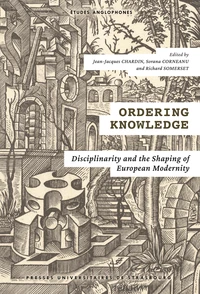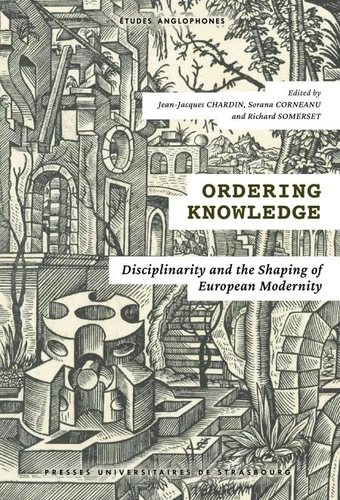
Ordering Knowledge. Disciplinarity and the Shaping of European Modernity
Par : , ,Formats :
Disponible dans votre compte client Decitre ou Furet du Nord dès validation de votre commande. Le format Multi-format est :
- Pour les liseuses autres que Vivlio, vous devez utiliser le logiciel Adobe Digital Edition. Non compatible avec la lecture sur les liseuses Kindle, Remarkable et Sony
 , qui est-ce ?
Notre partenaire de plateforme de lecture numérique où vous retrouverez l'ensemble de vos ebooks gratuitement
Pour en savoir plus sur nos ebooks, consultez notre aide en ligne ici
C'est si simple ! Lisez votre ebook avec l'app Vivlio sur votre tablette, mobile ou ordinateur :

- Nombre de pages344
- FormatMulti-format
- ISBN979-10-344-0361-5
- EAN9791034403615
- Date de parution02/05/2023
- Protection num.pas de protection
- Infos supplémentairesMulti-Format
- ÉditeurPresses universitaires de Strasb...
Résumé
As the world struggles to come to grips with the rise of new populisms that call into question the legitimacy of technocratic expertise, the historical understanding of the processes by which the characteristically modern modes of meaning-making came into existence has never been so important. Politically-motivated attacks on 'science' are difficult to counter in a climate of generalised scepticism for all forms of authority, but cultural historians have an important part to play by offering an adequate historical framing for the terms of the debate.
The origins of modernity are routinely associated with the empirical attitudes of the 'scientific revolution' and the liberal rationalism of the Enlightenment; but this story tends to be studied either conceptually by historians of science, or politically by cultural historians. For it to make sense as the backdrop to modern debates, the political and epistemological dimensions of the emergence of modernity need to be put more firmly into contact with one another.
This book attempts to do so by focusing on the theme of the emergence of disciplinarity in the seventeenth and eighteenth centuries.
The origins of modernity are routinely associated with the empirical attitudes of the 'scientific revolution' and the liberal rationalism of the Enlightenment; but this story tends to be studied either conceptually by historians of science, or politically by cultural historians. For it to make sense as the backdrop to modern debates, the political and epistemological dimensions of the emergence of modernity need to be put more firmly into contact with one another.
This book attempts to do so by focusing on the theme of the emergence of disciplinarity in the seventeenth and eighteenth centuries.