SOLDES
Jusqu'à -70% sur une sélection d'articles*

Nouveauté
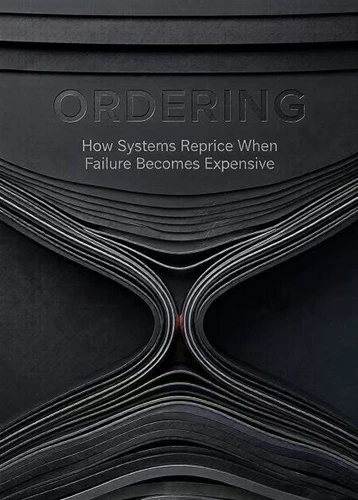
ORDERING: How Systems Reprice When Failure Becomes Expensive
Par :Formats :
Disponible dans votre compte client Decitre ou Furet du Nord dès validation de votre commande. Le format ePub est :
- Compatible avec une lecture sur My Vivlio (smartphone, tablette, ordinateur)
- Compatible avec une lecture sur liseuses Vivlio
- Pour les liseuses autres que Vivlio, vous devez utiliser le logiciel Adobe Digital Edition. Non compatible avec la lecture sur les liseuses Kindle, Remarkable et Sony
 , qui est-ce ?
Notre partenaire de plateforme de lecture numérique où vous retrouverez l'ensemble de vos ebooks gratuitement
Pour en savoir plus sur nos ebooks, consultez notre aide en ligne ici
C'est si simple ! Lisez votre ebook avec l'app Vivlio sur votre tablette, mobile ou ordinateur :

- FormatePub
- ISBN8235094802
- EAN9798235094802
- Date de parution16/05/2026
- Protection num.pas de protection
- Infos supplémentairesepub
- ÉditeurIoakim Ioakim
Résumé
Ordering: How Systems Reprice When Failure Becomes Expensive is a structural field guide to high-stakes systems. A better offer can still lose the file. The proposal may be cleaner. The contract may be stronger. The timeline may be faster. The economics may be better. Yet the system may still refuse to move. This rarely happens because the offer is flawed. It happens because the case is no longer priced at the visible interface. This book decodes how systems operate under pressure. It is not an ideological thesis, a managerial slogan, or a universal control theory.
It is a clinical diagnostic framework for understanding system behavior as failure costs escalate. When failure grows costly, systems do not merely optimize - they reorder. Surface procedures remain intact: meetings proceed, contracts retain validity, and formal discourse stays polite. Even so, decisive weight shifts away from visible interfaces and sinks into deeper layers of system logic: survival priority, risk reversibility, exposure control, and long-cycle continuity. The book centers on one complete causal mechanism chain: Constraint ? Pressure ? Firmware ? Decision Stack ? Decision Drop ? Reclassification ? Managed Variable ? Deep Time Through this structural chain, Ordering explains: .
why speed, transparency, efficiency, and scale cease to be reliable advantages under pressure; . how formal compliance gradually loses practical causal force; . why trusted partners are reclassified as systemic risk variables; . how core decision weight migrates beneath standardized procedures; . how proactive action turns into structural load within high-pressure system fields; . how iterated managed variables form durable deep-time system memory. Systems do not always operate by their stated rules.
Under pressure, they order behavior by the cost of failure.
It is a clinical diagnostic framework for understanding system behavior as failure costs escalate. When failure grows costly, systems do not merely optimize - they reorder. Surface procedures remain intact: meetings proceed, contracts retain validity, and formal discourse stays polite. Even so, decisive weight shifts away from visible interfaces and sinks into deeper layers of system logic: survival priority, risk reversibility, exposure control, and long-cycle continuity. The book centers on one complete causal mechanism chain: Constraint ? Pressure ? Firmware ? Decision Stack ? Decision Drop ? Reclassification ? Managed Variable ? Deep Time Through this structural chain, Ordering explains: .
why speed, transparency, efficiency, and scale cease to be reliable advantages under pressure; . how formal compliance gradually loses practical causal force; . why trusted partners are reclassified as systemic risk variables; . how core decision weight migrates beneath standardized procedures; . how proactive action turns into structural load within high-pressure system fields; . how iterated managed variables form durable deep-time system memory. Systems do not always operate by their stated rules.
Under pressure, they order behavior by the cost of failure.