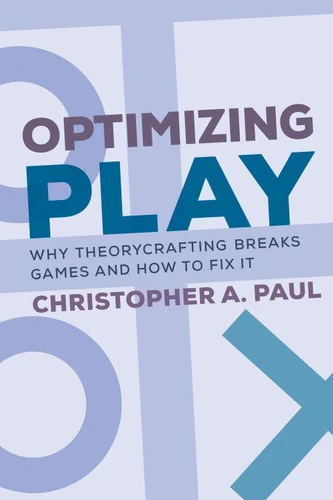
An unexpected take on how games work, what the stakes are for them, and how game designers can avoid the traps of optimization. The process of optimization in games seems like a good thing-who wouldn't want to find the most efficient way to play and win? As Christopher Paul argues in Optimizing Play, however, optimization can sometimes risk a tragedy of the commons, where actions that are good for individuals jeopardize the overall state of the game for everyone else.
As he explains, players inadvertently limit play as they theorycraft, seeking optimal choices. The process of developing a meta, or the most effective tactic available, structures decision making, causing play to stagnate. A "stale" meta then creates a perception that a game is solved and may lead players to turn away from the game. Drawing on insights from game studies, rhetoric, the history of science, ecology, and game theory literature, Paul explores the problem of optimization in a range of video games, including Overwatch, FIFA/EA Sports FC, NBA 2K, Clash Royale, World of Warcraft, and League of Legends.
He also pulls extensively from data analytics in sports, where the problem has progressed further and is even more intractable than it is in video games, given the money sports teams invest to find an edge. Finally, Paul offers concrete and specific suggestions for how games can be developed to avoid the trap set by optimization run amok.
An unexpected take on how games work, what the stakes are for them, and how game designers can avoid the traps of optimization. The process of optimization in games seems like a good thing-who wouldn't want to find the most efficient way to play and win? As Christopher Paul argues in Optimizing Play, however, optimization can sometimes risk a tragedy of the commons, where actions that are good for individuals jeopardize the overall state of the game for everyone else.
As he explains, players inadvertently limit play as they theorycraft, seeking optimal choices. The process of developing a meta, or the most effective tactic available, structures decision making, causing play to stagnate. A "stale" meta then creates a perception that a game is solved and may lead players to turn away from the game. Drawing on insights from game studies, rhetoric, the history of science, ecology, and game theory literature, Paul explores the problem of optimization in a range of video games, including Overwatch, FIFA/EA Sports FC, NBA 2K, Clash Royale, World of Warcraft, and League of Legends.
He also pulls extensively from data analytics in sports, where the problem has progressed further and is even more intractable than it is in video games, given the money sports teams invest to find an edge. Finally, Paul offers concrete and specific suggestions for how games can be developed to avoid the trap set by optimization run amok.


 , qui est-ce ?