
Nouveauté
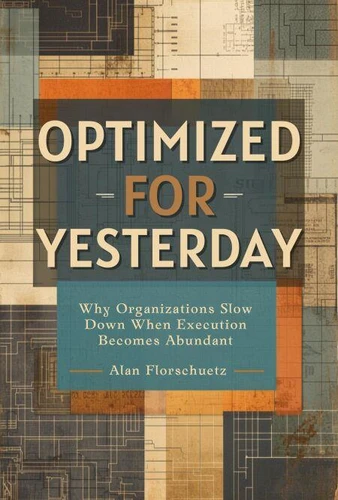
Optimized for Yesterday
Par :Formats :
Disponible dans votre compte client Decitre ou Furet du Nord dès validation de votre commande. Le format ePub est :
- Compatible avec une lecture sur My Vivlio (smartphone, tablette, ordinateur)
- Compatible avec une lecture sur liseuses Vivlio
- Pour les liseuses autres que Vivlio, vous devez utiliser le logiciel Adobe Digital Edition. Non compatible avec la lecture sur les liseuses Kindle, Remarkable et Sony
 , qui est-ce ?
Notre partenaire de plateforme de lecture numérique où vous retrouverez l'ensemble de vos ebooks gratuitement
Pour en savoir plus sur nos ebooks, consultez notre aide en ligne ici
C'est si simple ! Lisez votre ebook avec l'app Vivlio sur votre tablette, mobile ou ordinateur :

- FormatePub
- ISBN8997125912
- EAN9798997125912
- Date de parution07/08/2026
- Protection num.pas de protection
- Infos supplémentairesepub
- ÉditeurAlan Florschuetz
Résumé
AI changed how we build software. It hasn't changed how most organizations decide. Capable engineers can now accomplish in hours what once required weeks. Yet projects still stall in approval cycles, planning reviews, and the pursuit of confidence that never quite arrives. The bottleneck moved-from implementation to decision-making-and most organizations haven't noticed. Project Intent is a framework for leading in an era where intelligence is abundant and execution is cheap.
Drawing on decades of enterprise software experience, this book introduces a set of interconnected ideas that redefine how organizations should operate when AI changes the fundamental economics of building:Decision Latency - Why organizations optimized for confidence are being outperformed by organizations optimized for learning. Intent Before Implementation - Why the most valuable engineering artifact is no longer code, but clarity of purpose.
The Economics of Expertise - Why the cross-functional team was a response to distributed expertise-and what happens when expertise becomes accessible. Guided Autonomy - How leadership creates value by defining boundaries rather than controlling decisions. This is not a book about AI tools or prompt engineering. It is a book about leadership, organizational design, and the discipline required to convert intelligence into outcomes.
It is for CTOs, engineering leaders, product executives, and anyone responsible for how their organization decides, learns, and adapts. Planning produces predictions. Execution produces evidence. The organizations that learn the difference fastest will define the next era of enterprise computing. Project Intent is vendor-neutral, implementation-agnostic, and written for leaders ready to redesign their operating model-not just their technology stack.
Drawing on decades of enterprise software experience, this book introduces a set of interconnected ideas that redefine how organizations should operate when AI changes the fundamental economics of building:Decision Latency - Why organizations optimized for confidence are being outperformed by organizations optimized for learning. Intent Before Implementation - Why the most valuable engineering artifact is no longer code, but clarity of purpose.
The Economics of Expertise - Why the cross-functional team was a response to distributed expertise-and what happens when expertise becomes accessible. Guided Autonomy - How leadership creates value by defining boundaries rather than controlling decisions. This is not a book about AI tools or prompt engineering. It is a book about leadership, organizational design, and the discipline required to convert intelligence into outcomes.
It is for CTOs, engineering leaders, product executives, and anyone responsible for how their organization decides, learns, and adapts. Planning produces predictions. Execution produces evidence. The organizations that learn the difference fastest will define the next era of enterprise computing. Project Intent is vendor-neutral, implementation-agnostic, and written for leaders ready to redesign their operating model-not just their technology stack.