
Nouveauté
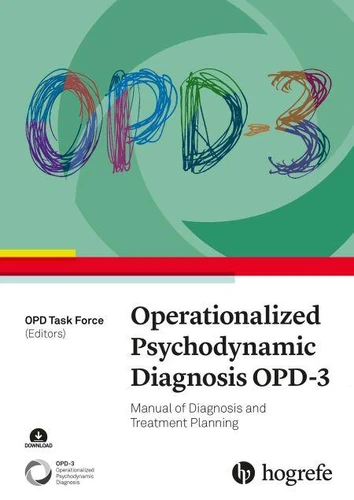
Operationalized Psychodynamic Diagnosis OPD-3. Manual of Diagnosis and Treatment Planning
Par :Formats :
Disponible dans votre compte client Decitre ou Furet du Nord dès validation de votre commande. Le format PDF est :
- Compatible avec une lecture sur My Vivlio (smartphone, tablette, ordinateur)
- Compatible avec une lecture sur liseuses Vivlio
- Pour les liseuses autres que Vivlio, vous devez utiliser le logiciel Adobe Digital Edition. Non compatible avec la lecture sur les liseuses Kindle, Remarkable et Sony
 , qui est-ce ?
Notre partenaire de plateforme de lecture numérique où vous retrouverez l'ensemble de vos ebooks gratuitement
Pour en savoir plus sur nos ebooks, consultez notre aide en ligne ici
C'est si simple ! Lisez votre ebook avec l'app Vivlio sur votre tablette, mobile ou ordinateur :

- Nombre de pages332
- FormatPDF
- ISBN978-1-61676-671-9
- EAN9781616766719
- Date de parution13/07/2026
- Protection num.Digital Watermarking
- Taille4 Mo
- Infos supplémentairespdf
- ÉditeurHogrefe Publishing
Résumé
The Operationalized Psychodynamic Diagnosis (OPD) is a multiaxial
psychodynamic diagnostic system that has become a widely accepted
standard in psychodynamic diagnostics for clinical practice and research in
many countries. Numerous empirical studies have demonstrated the
validity of OPD findings.
Through its clear operationalization of essential components of
psychodynamic models - subjective experiences of illness and treatment
ideas, problematic relationship patterns, intrapsychic conflicts, and
personality functioning (i.e., structural integration) - the OPD enables
reliable assessment, which is further aided by a wealth of case examples
and working materials.
The OPD-3 is organized in four axes: . Axis I: Mental Disorders, Experience of Illness, and Prerequisites for Treatment . Axis II: Interpersonal relations . Axis III: Conflict . Axis IV: Structure New in OPD-3: All axes have been further refined with a stronger emphasis on dimensionally-oriented assessment. The dynamic interplay of the axes, especially between conflict and structure, is represented with greater differentiation.
Since the OPD is based on a semi-standardized, clinically- oriented interview, this manual is equally suitable for both research and clinical practice. It is an indispensable companion for choosing the most fitting diagnostic tests, determining the focus of treatment, and therapy planning.
The OPD-3 is organized in four axes: . Axis I: Mental Disorders, Experience of Illness, and Prerequisites for Treatment . Axis II: Interpersonal relations . Axis III: Conflict . Axis IV: Structure New in OPD-3: All axes have been further refined with a stronger emphasis on dimensionally-oriented assessment. The dynamic interplay of the axes, especially between conflict and structure, is represented with greater differentiation.
Since the OPD is based on a semi-standardized, clinically- oriented interview, this manual is equally suitable for both research and clinical practice. It is an indispensable companion for choosing the most fitting diagnostic tests, determining the focus of treatment, and therapy planning.