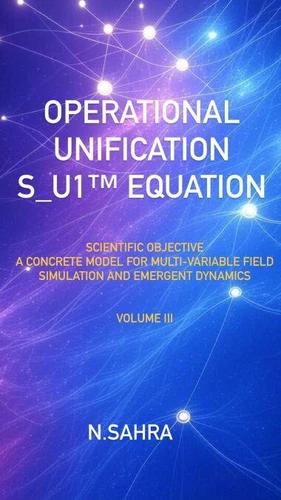
S_U1T: A Symbolic Framework for Unified ModelingBy N. SahraVolume III continues the evolution of the S_U1T Equation, a symbolic formalism designed to explore connections between relativistic and quantum domains. Building on the theoretical groundwork of Volumes I and II, this volume introduces dynamic multi-agent simulations, showcasing structured interactions such as signal stretching under symbolic dark energy and adaptive agent behavior.
S_U1T is not presented as a physical theory but as a simulation framework: a new language to test ideas, formalize relationships, and invite scientific exploration. Key variables like Consc(P) and DE_Dyn(P) are symbolic, not empirical claims but function as tools within a structured model. This work does not claim final answers. It offers a rigorous starting point for those curious about symbolic unification, simulation design, and systems thinking.
Scientists, developers, and interdisciplinary thinkers are invited to critique, test, and expand the framework, treating this eBook as both an introduction and a call to further inquiry. For readers of systems modeling, simulation theory, symbolic computation, or theoretical unification, S_U1T opens a structured path toward new scientific frontiers.
S_U1T: A Symbolic Framework for Unified ModelingBy N. SahraVolume III continues the evolution of the S_U1T Equation, a symbolic formalism designed to explore connections between relativistic and quantum domains. Building on the theoretical groundwork of Volumes I and II, this volume introduces dynamic multi-agent simulations, showcasing structured interactions such as signal stretching under symbolic dark energy and adaptive agent behavior.
S_U1T is not presented as a physical theory but as a simulation framework: a new language to test ideas, formalize relationships, and invite scientific exploration. Key variables like Consc(P) and DE_Dyn(P) are symbolic, not empirical claims but function as tools within a structured model. This work does not claim final answers. It offers a rigorous starting point for those curious about symbolic unification, simulation design, and systems thinking.
Scientists, developers, and interdisciplinary thinkers are invited to critique, test, and expand the framework, treating this eBook as both an introduction and a call to further inquiry. For readers of systems modeling, simulation theory, symbolic computation, or theoretical unification, S_U1T opens a structured path toward new scientific frontiers.

 , qui est-ce ?