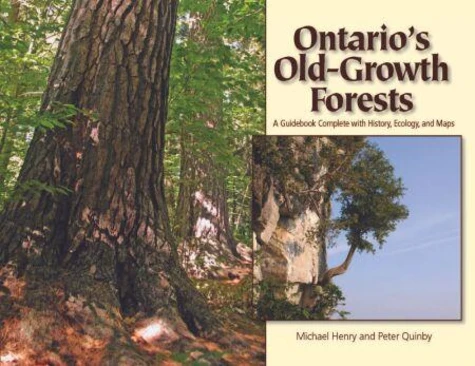



Michael Henry studied botany in university and spent a decade doing scientific research in Ontario's old-growth forests with the organization Ancient Forest Exploration & Research. He has visited more of Ontario's old-growth forests than most people alive today, and has written reports, trail guides and magazine articles on the topic. He designed and constructed the Blueberry Lake Ecology Trails in Temagami, Ontario.
While he is a passionate advocate for forests, he has also selectively logged trees from a woodlot in southern Quebec, and enjoys woodworking. For the past several years he has been building straw bale homes with Camel's Back Construction based near his home in Peterborough, Ontario. Dr. Peter Quinby is Chair of Ancient Forest Exploration & Research, a charitable NGO that he created in 1992 with a mandate to conduct research and educational activities focusing on the ecology and protection of natural forested landscapes in Ontario.
His connection to Ontario's old-growth forests began at the age of six months when his parents took him to their cottage in Algonquin Park for his first of many summers there. He has written numerous journal articles, technical reports, and educational pieces. He is most familiar with the forested landscapes of Algonquin and Temagami, located in central Ontario. He has held positions at a number of universities including the University of Pittsburgh and Wilfrid Laurier University.
Currently, he is employed as a senior environmental scientist with Knight Piesold Ltd. in North Bay, Ontario, where he works primarily on environmental impact assessment projects in the Canadian arctic.
While he is a passionate advocate for forests, he has also selectively logged trees from a woodlot in southern Quebec, and enjoys woodworking. For the past several years he has been building straw bale homes with Camel's Back Construction based near his home in Peterborough, Ontario. Dr. Peter Quinby is Chair of Ancient Forest Exploration & Research, a charitable NGO that he created in 1992 with a mandate to conduct research and educational activities focusing on the ecology and protection of natural forested landscapes in Ontario.
His connection to Ontario's old-growth forests began at the age of six months when his parents took him to their cottage in Algonquin Park for his first of many summers there. He has written numerous journal articles, technical reports, and educational pieces. He is most familiar with the forested landscapes of Algonquin and Temagami, located in central Ontario. He has held positions at a number of universities including the University of Pittsburgh and Wilfrid Laurier University.
Currently, he is employed as a senior environmental scientist with Knight Piesold Ltd. in North Bay, Ontario, where he works primarily on environmental impact assessment projects in the Canadian arctic.