SOLDES
Jusqu'à -70% sur une sélection d'articles*

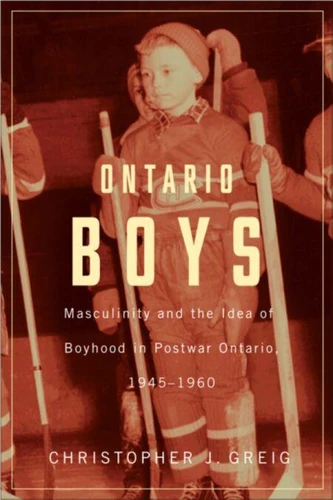
Ontario Boys. Masculinity and the Idea of Boyhood in Postwar Ontario, 1945--1960
Par :Formats :
Disponible dans votre compte client Decitre ou Furet du Nord dès validation de votre commande. Le format ePub est :
- Compatible avec une lecture sur My Vivlio (smartphone, tablette, ordinateur)
- Compatible avec une lecture sur liseuses Vivlio
- Pour les liseuses autres que Vivlio, vous devez utiliser le logiciel Adobe Digital Edition. Non compatible avec la lecture sur les liseuses Kindle, Remarkable et Sony
 , qui est-ce ?
Notre partenaire de plateforme de lecture numérique où vous retrouverez l'ensemble de vos ebooks gratuitement
Pour en savoir plus sur nos ebooks, consultez notre aide en ligne ici
C'est si simple ! Lisez votre ebook avec l'app Vivlio sur votre tablette, mobile ou ordinateur :

- Nombre de pages220
- FormatePub
- ISBN978-1-55458-902-9
- EAN9781554589029
- Date de parution04/02/2014
- Protection num.Digital Watermarking
- Taille2 Mo
- Infos supplémentairesepub
- ÉditeurWilfrid Laurier University Press
Résumé
Ontario Boys explores the preoccupation with boyhood in Ontario during the immediate postwar period, 1945-1960. It argues that a traditional version of boyhood was being rejuvenated in response to a population fraught with uncertainty, and suffering from insecurity, instability, and gender anxiety brought on by depression-era and wartime disruptions in marital, familial, and labour relations, as well as mass migration, rapid postwar economic changes, the emergence of the Cold War, and the looming threat of atomic annihilation.
In this sociopolitical and cultural context, concerned adults began to cast the fate of the postwar world onto children, in particular boys. In the decade and a half immediately following World War II, the version of boyhood that became the ideal was one that stressed selflessness, togetherness, honesty, fearlessness, frank determination, and emotional toughness. It was thought that investing boys with this version of masculinity was essential if they were to grow into the kind of citizens capable of governing, protecting, and defending the nation, and, of course, maintaining and regulating the social order.
Drawing on a wide variety of sources, Ontario Boys demonstrates that, although girls were expected and encouraged to internalize a "special kind" of citizenship, as caregivers and educators of children and nurturers of men, the gendered content and language employed indicated that active public citizenship and democracy was intended for boys. An "appropriate" boyhood in the postwar period became, if nothing else, a metaphor for the survival of the nation.
In this sociopolitical and cultural context, concerned adults began to cast the fate of the postwar world onto children, in particular boys. In the decade and a half immediately following World War II, the version of boyhood that became the ideal was one that stressed selflessness, togetherness, honesty, fearlessness, frank determination, and emotional toughness. It was thought that investing boys with this version of masculinity was essential if they were to grow into the kind of citizens capable of governing, protecting, and defending the nation, and, of course, maintaining and regulating the social order.
Drawing on a wide variety of sources, Ontario Boys demonstrates that, although girls were expected and encouraged to internalize a "special kind" of citizenship, as caregivers and educators of children and nurturers of men, the gendered content and language employed indicated that active public citizenship and democracy was intended for boys. An "appropriate" boyhood in the postwar period became, if nothing else, a metaphor for the survival of the nation.