SOLDES
Jusqu'à -70% sur une sélection d'articles*

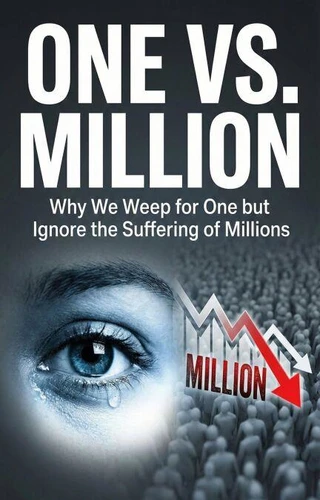
One vs. Million. Why We Weep for One but Ignore the Suffering of Millions
Par :Formats :
Disponible dans votre compte client Decitre ou Furet du Nord dès validation de votre commande. Le format ePub est :
- Compatible avec une lecture sur My Vivlio (smartphone, tablette, ordinateur)
- Compatible avec une lecture sur liseuses Vivlio
- Pour les liseuses autres que Vivlio, vous devez utiliser le logiciel Adobe Digital Edition. Non compatible avec la lecture sur les liseuses Kindle, Remarkable et Sony
 , qui est-ce ?
Notre partenaire de plateforme de lecture numérique où vous retrouverez l'ensemble de vos ebooks gratuitement
Pour en savoir plus sur nos ebooks, consultez notre aide en ligne ici
C'est si simple ! Lisez votre ebook avec l'app Vivlio sur votre tablette, mobile ou ordinateur :

- Nombre de pages206
- FormatePub
- ISBN978-3-565-26413-1
- EAN9783565264131
- Date de parution22/02/2026
- Protection num.pas de protection
- Taille566 Ko
- Infos supplémentairesepub
- ÉditeurEmphaloz Publishing House
Résumé
Mother Teresa once said, "If I look at the mass, I will never act. If I look at the one, I will." This is the psychological reality of "Compassion Fade" or the "Identifiable Victim Effect." Our brains are wired to feel intense empathy for a single tragedy-a child in a well, a stranded dog-but as the number of victims rises, our emotional engagement paradoxically shuts down. We care less about 100 people than we do about one.
This book explores the evolutionary reasons for this moral bug.
We evolved to care for a small tribe, not a statistical dataset. The author explains how charities, news media, and politicians manipulate this bias, and how we can train ourselves to overcome it. By understanding the arithmetic of compassion, we can learn to make decisions based on impact rather than narrative, and ensure that our empathy scales with the magnitude of the suffering.
We evolved to care for a small tribe, not a statistical dataset. The author explains how charities, news media, and politicians manipulate this bias, and how we can train ourselves to overcome it. By understanding the arithmetic of compassion, we can learn to make decisions based on impact rather than narrative, and ensure that our empathy scales with the magnitude of the suffering.