SOLDES
Jusqu'à -70% sur une sélection d'articles*

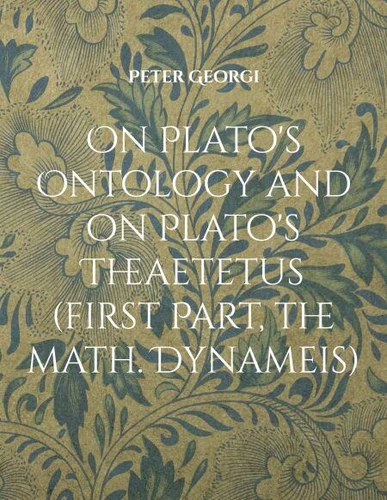
On Plato's Ontology and on Plato's Theaetetus (first Part, the math. Dynameis)
Par :Formats :
Disponible dans votre compte client Decitre ou Furet du Nord dès validation de votre commande. Le format ePub est :
- Compatible avec une lecture sur My Vivlio (smartphone, tablette, ordinateur)
- Compatible avec une lecture sur liseuses Vivlio
- Pour les liseuses autres que Vivlio, vous devez utiliser le logiciel Adobe Digital Edition. Non compatible avec la lecture sur les liseuses Kindle, Remarkable et Sony
 , qui est-ce ?
Notre partenaire de plateforme de lecture numérique où vous retrouverez l'ensemble de vos ebooks gratuitement
Pour en savoir plus sur nos ebooks, consultez notre aide en ligne ici
C'est si simple ! Lisez votre ebook avec l'app Vivlio sur votre tablette, mobile ou ordinateur :

- Nombre de pages148
- FormatePub
- ISBN978-3-7693-9083-4
- EAN9783769390834
- Date de parution04/12/2024
- Protection num.Digital Watermarking
- Taille1 Mo
- Infos supplémentairesepub
- ÉditeurBoD - Books on Demand
Résumé
The Ontology part of the book is shown first in the title because of its more general, weightier meaning; but it has emerged from the Theaetetus part and is thus found after it. Both parts of the book can be read largely independently of each other.
On the Theaetetus part: The dialogue Theaetetus is dedicated to the question: Knowledge - what is it actually? In the dialogue, it is problematized how the concept of something at all, so also that of knowledge, can be determined.
The 'famous' dynamis passage plays an essential role in this. To the passage substantial new issues are shown. In addition, there is a new perspective on the attempts in the initial dialogue part to determine what knowledge is. On the Ontology part: Here, starting from the dialogue Phaedo, a model of Plato's ontology is developed with provided means of mathematical logic. The model, in particular his version of concept, enables (to the author's knowledge) a partially new understanding of Plato's so-called theory of ideas.
The 'famous' dynamis passage plays an essential role in this. To the passage substantial new issues are shown. In addition, there is a new perspective on the attempts in the initial dialogue part to determine what knowledge is. On the Ontology part: Here, starting from the dialogue Phaedo, a model of Plato's ontology is developed with provided means of mathematical logic. The model, in particular his version of concept, enables (to the author's knowledge) a partially new understanding of Plato's so-called theory of ideas.