
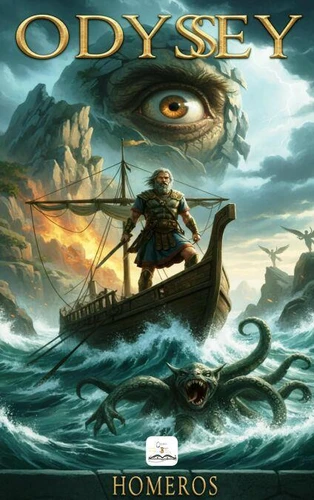
Odyssey. {Annotated & Illustrated}
Par :Formats :
Disponible dans votre compte client Decitre ou Furet du Nord dès validation de votre commande. Le format ePub est :
- Compatible avec une lecture sur My Vivlio (smartphone, tablette, ordinateur)
- Compatible avec une lecture sur liseuses Vivlio
- Pour les liseuses autres que Vivlio, vous devez utiliser le logiciel Adobe Digital Edition. Non compatible avec la lecture sur les liseuses Kindle, Remarkable et Sony
 , qui est-ce ?
Notre partenaire de plateforme de lecture numérique où vous retrouverez l'ensemble de vos ebooks gratuitement
Pour en savoir plus sur nos ebooks, consultez notre aide en ligne ici
C'est si simple ! Lisez votre ebook avec l'app Vivlio sur votre tablette, mobile ou ordinateur :

- Nombre de pages461
- FormatePub
- ISBN978-625-387-630-2
- EAN9786253876302
- Date de parution09/04/2026
- Protection num.Digital Watermarking
- Taille5 Mo
- Infos supplémentairesepub
- ÉditeurE-Kitap Projesi & Cheapest Boo
Résumé
The Odyssey begins ten years after the end of the ten-year Trojan War (that is the subject of the Iliad), and Odysseus has still not returned home from the war. Odysseus' son Telemachus is about 20 years old and is sharing his absent father's house on the island of Ithaca with his mother Penelope and a crowd of 108 boisterous young men, "the Suitors", whose aim is to persuade Penelope to marry one of them, all the while enjoying the hospitality of Odysseus' household and eating up his wealth.
Odysseus' protectress, the goddess Athena, discusses his fate with Zeus, king of the gods, at a moment when Odysseus' enemy, the god of the sea Poseidon, is absent from Mount Olympus.
Then, disguised as a Taphian chieftain named Mentes, she visits Telemachus to urge him to search for news of his father. He offers her hospitality; they observe the Suitors dining rowdily while the bard Phemius performs a narrative poem for them. Penelope objects to Phemius' theme, the "Return from Troy".
Then, disguised as a Taphian chieftain named Mentes, she visits Telemachus to urge him to search for news of his father. He offers her hospitality; they observe the Suitors dining rowdily while the bard Phemius performs a narrative poem for them. Penelope objects to Phemius' theme, the "Return from Troy".