
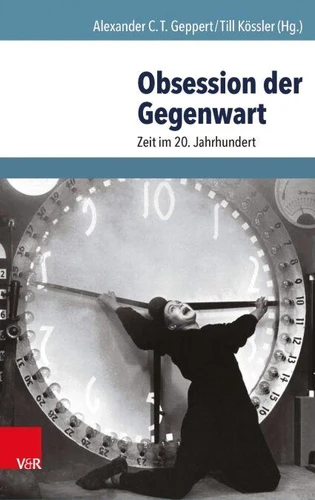
Obsession der Gegenwart. Zeit im 20. Jahrhundert
Par : ,Formats :
Disponible dans votre compte client Decitre ou Furet du Nord dès validation de votre commande. Le format PDF est :
- Compatible avec une lecture sur My Vivlio (smartphone, tablette, ordinateur)
- Compatible avec une lecture sur liseuses Vivlio
- Pour les liseuses autres que Vivlio, vous devez utiliser le logiciel Adobe Digital Edition. Non compatible avec la lecture sur les liseuses Kindle, Remarkable et Sony
 , qui est-ce ?
Notre partenaire de plateforme de lecture numérique où vous retrouverez l'ensemble de vos ebooks gratuitement
Pour en savoir plus sur nos ebooks, consultez notre aide en ligne ici
C'est si simple ! Lisez votre ebook avec l'app Vivlio sur votre tablette, mobile ou ordinateur :

- Nombre de pages287
- FormatPDF
- ISBN978-3-647-36425-4
- EAN9783647364254
- Date de parution28/10/2015
- Protection num.pas de protection
- Taille3 Mo
- Infos supplémentairespdf
- ÉditeurVandenhoeck & Ruprecht
Résumé
Time is an obsession of the present, yet current debates seem largely unaware of its historical formation throughout the twentieth century. Given a century characterized by frequent ruptures and supersessions of competing temporal regimes, it is remarkable that time has not played a more central role in its historicisation, neither as analytical category nor thematic research subject. The nine articles in this special issue, set in Germany, England, Spain and Japan, pursue both perspectives.
On the one hand they examine the conceptual role, function and importance of >time< in and for the writing of history; on the other they analyse changing régimes d'historicité and the transformation of time practices empirically. Criticising established standard narratives of a global >standardization< of time or its relentless >acceleration<, this volume rather emphasizes the pluritemporality of the twentieth century and foregrounds the historical preconditions of our digitally-driven present-day simultaneities.
Thus, it explores the possibilities of the historicisation of >time< as a fundamental category for thinking the twentieth century and offers a building block for a new >time-history<.
On the one hand they examine the conceptual role, function and importance of >time< in and for the writing of history; on the other they analyse changing régimes d'historicité and the transformation of time practices empirically. Criticising established standard narratives of a global >standardization< of time or its relentless >acceleration<, this volume rather emphasizes the pluritemporality of the twentieth century and foregrounds the historical preconditions of our digitally-driven present-day simultaneities.
Thus, it explores the possibilities of the historicisation of >time< as a fundamental category for thinking the twentieth century and offers a building block for a new >time-history<.