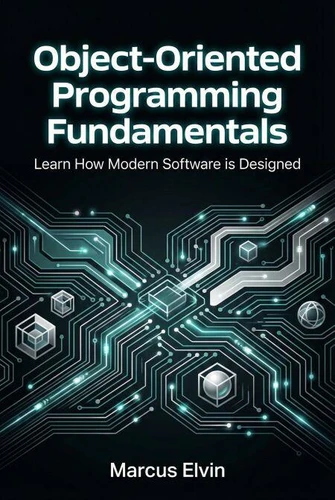
Object-Oriented Programming Fundamentals: Learn How Modern Software is Designed
Par :Formats :
Disponible dans votre compte client Decitre ou Furet du Nord dès validation de votre commande. Le format ePub protégé est :
- Compatible avec une lecture sur My Vivlio (smartphone, tablette, ordinateur)
- Compatible avec une lecture sur liseuses Vivlio
- Pour les liseuses autres que Vivlio, vous devez utiliser le logiciel Adobe Digital Edition. Non compatible avec la lecture sur les liseuses Kindle, Remarkable et Sony
- Non compatible avec un achat hors France métropolitaine
 , qui est-ce ?
Notre partenaire de plateforme de lecture numérique où vous retrouverez l'ensemble de vos ebooks gratuitement
Pour en savoir plus sur nos ebooks, consultez notre aide en ligne ici
C'est si simple ! Lisez votre ebook avec l'app Vivlio sur votre tablette, mobile ou ordinateur :

- FormatePub
- ISBN8233933851
- EAN9798233933851
- Date de parution25/01/2026
- Protection num.Adobe DRM
- Infos supplémentairesepub
- ÉditeurLinda Balsamo
Résumé
Build Software That Scales, Adapts, and LastsAnyone can write code that runs once. Professional developers write code that teams can maintain, extend, and trust for years. Object-Oriented Programming Fundamentals teaches you the design principles that separate hobbyist scripts from enterprise-grade software systems. This comprehensive guide rewires how you approach programming problems. You'll learn to organize code using the same mental models humans naturally use to understand the world.
Through practical examples and clear explanations that work across all major programming languages, you'll master the architectural foundations used in production systems worldwide. Core Skills You'll DevelopBuild on the four foundational pillars: encapsulation, abstraction, inheritance, and polymorphism. Learn to protect code integrity, simplify complex systems, eliminate redundant logic, and create flexible architectures that welcome future requirements.
Apply SOLID principles that distinguish professional engineers from casual coders. Understand single responsibility design, open-closed architecture, interface segregation, and dependency inversion patterns that make codebases maintainable at scale. Implement battle-tested design patterns including Factory, Singleton, Observer, Strategy, and Decorator. Recognize when each pattern solves specific challenges and how to apply them in your projects.
Structure classes that mirror real business domains. Go beyond syntax to master responsibility assignment, coupling reduction, cohesion improvement, and architecture that communicates intent clearly. Create and interpret UML class diagrams used in professional documentation. Communicate design decisions visually using industry-standard notation that technical teams recognize immediately. Designed For Your SuccessIdeal for developers moving beyond procedural thinking, students connecting academic theory to practical application, and self-learners ready for professional-level work.
Language-agnostic approach uses clear pseudocode applicable to Java, Python, C#, JavaScript, Ruby, and other object-oriented languages. Think Like an ArchitectThis guide emphasizes understanding over memorization. Build transferable mental models that remain valuable regardless of framework trends or language evolution. You'll design robust systems, not just write functional code. Complete Learning PackageTwenty progressive chapters across four carefully structured parts take you from foundational concepts to advanced real-world practices.
Extensive appendices include comprehensive glossaries, principle summaries, pattern catalogs, and cross-language reference guides. What Makes This DifferentFocus on design thinking rather than syntax memorization. Learn why architectural decisions matter before diving into implementation details. Understand when to use object-oriented approaches and when alternative paradigms serve better. Elevate your programming practice.
Design software systems that your future self will thank you for building.
Through practical examples and clear explanations that work across all major programming languages, you'll master the architectural foundations used in production systems worldwide. Core Skills You'll DevelopBuild on the four foundational pillars: encapsulation, abstraction, inheritance, and polymorphism. Learn to protect code integrity, simplify complex systems, eliminate redundant logic, and create flexible architectures that welcome future requirements.
Apply SOLID principles that distinguish professional engineers from casual coders. Understand single responsibility design, open-closed architecture, interface segregation, and dependency inversion patterns that make codebases maintainable at scale. Implement battle-tested design patterns including Factory, Singleton, Observer, Strategy, and Decorator. Recognize when each pattern solves specific challenges and how to apply them in your projects.
Structure classes that mirror real business domains. Go beyond syntax to master responsibility assignment, coupling reduction, cohesion improvement, and architecture that communicates intent clearly. Create and interpret UML class diagrams used in professional documentation. Communicate design decisions visually using industry-standard notation that technical teams recognize immediately. Designed For Your SuccessIdeal for developers moving beyond procedural thinking, students connecting academic theory to practical application, and self-learners ready for professional-level work.
Language-agnostic approach uses clear pseudocode applicable to Java, Python, C#, JavaScript, Ruby, and other object-oriented languages. Think Like an ArchitectThis guide emphasizes understanding over memorization. Build transferable mental models that remain valuable regardless of framework trends or language evolution. You'll design robust systems, not just write functional code. Complete Learning PackageTwenty progressive chapters across four carefully structured parts take you from foundational concepts to advanced real-world practices.
Extensive appendices include comprehensive glossaries, principle summaries, pattern catalogs, and cross-language reference guides. What Makes This DifferentFocus on design thinking rather than syntax memorization. Learn why architectural decisions matter before diving into implementation details. Understand when to use object-oriented approaches and when alternative paradigms serve better. Elevate your programming practice.
Design software systems that your future self will thank you for building.