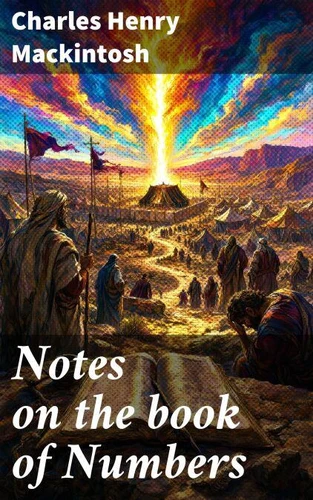
In Notes on the Book of Numbers, Charles Henry Mackintosh offers a devotional yet carefully structured exposition of the fourth book of the Pentateuch, tracing Israel's wilderness journey as a moral and spiritual education under divine government. Characteristic of nineteenth-century evangelical commentary, the work combines close reading, typological interpretation, and practical application, turning episodes of murmuring, discipline, priesthood, and pilgrimage into lessons for Christian faith and conduct.
Its style is lucid, exhortatory, and pastoral rather than technical, yet it is deeply rooted in Scripture's unity and in the Brethren emphasis on the believer's walk through a hostile world toward promised rest. Mackintosh (1820-1896), the well-known Irish Bible teacher of the Plymouth Brethren, wrote out of a lifelong commitment to making Scripture spiritually intelligible to ordinary readers. Best known for his Notes on the Pentateuch, he was shaped by the Brethren's distrust of mere formalism, their expectation of Christ's nearness, and their stress on the authority of the Bible.
These convictions clearly inform his treatment of Numbers as a book of testing, obedience, failure, and grace. This volume is especially recommended to readers seeking a classic devotional commentary that joins biblical exposition to self-examination. It will reward pastors, students, and thoughtful lay readers who want Numbers read not merely as ancient history, but as a living word for the pilgrim church.
In Notes on the Book of Numbers, Charles Henry Mackintosh offers a devotional yet carefully structured exposition of the fourth book of the Pentateuch, tracing Israel's wilderness journey as a moral and spiritual education under divine government. Characteristic of nineteenth-century evangelical commentary, the work combines close reading, typological interpretation, and practical application, turning episodes of murmuring, discipline, priesthood, and pilgrimage into lessons for Christian faith and conduct.
Its style is lucid, exhortatory, and pastoral rather than technical, yet it is deeply rooted in Scripture's unity and in the Brethren emphasis on the believer's walk through a hostile world toward promised rest. Mackintosh (1820-1896), the well-known Irish Bible teacher of the Plymouth Brethren, wrote out of a lifelong commitment to making Scripture spiritually intelligible to ordinary readers. Best known for his Notes on the Pentateuch, he was shaped by the Brethren's distrust of mere formalism, their expectation of Christ's nearness, and their stress on the authority of the Bible.
These convictions clearly inform his treatment of Numbers as a book of testing, obedience, failure, and grace. This volume is especially recommended to readers seeking a classic devotional commentary that joins biblical exposition to self-examination. It will reward pastors, students, and thoughtful lay readers who want Numbers read not merely as ancient history, but as a living word for the pilgrim church.


 , qui est-ce ?