
Louise Heldgaard Bylund is PhD Candidate at Aarhus University.
René Falkenberg is Associate Professor at Aarhus University.
Marianne Bjelland Kartzow is Professor at University of Oslo.
Kasper Bro Larsen, Ph. D., is Associate Professor of New Testament at Aarhus University, Denmark.
Louise Heldgaard Bylund is PhD Candidate at Aarhus University.
Jacob P. B. Mortensen, PhD, is Assistant Professor at Aarhus University (Denmark).
Maria Sturesson is doctoral student at the Lund University, Sweden.
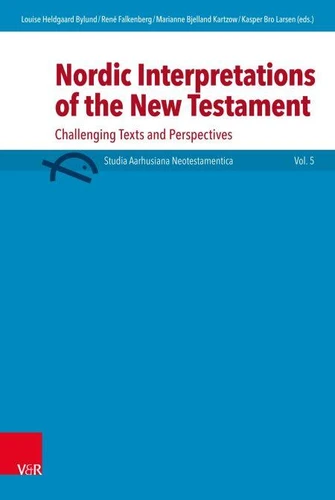
Nordic Interpretations of the New Testament. Challenging Texts and Perspectives
Par : , , , ,Formats :
Disponible dans votre compte client Decitre ou Furet du Nord dès validation de votre commande. Le format PDF est :
- Compatible avec une lecture sur My Vivlio (smartphone, tablette, ordinateur)
- Compatible avec une lecture sur liseuses Vivlio
- Pour les liseuses autres que Vivlio, vous devez utiliser le logiciel Adobe Digital Edition. Non compatible avec la lecture sur les liseuses Kindle, Remarkable et Sony
 , qui est-ce ?
Notre partenaire de plateforme de lecture numérique où vous retrouverez l'ensemble de vos ebooks gratuitement
Pour en savoir plus sur nos ebooks, consultez notre aide en ligne ici
C'est si simple ! Lisez votre ebook avec l'app Vivlio sur votre tablette, mobile ou ordinateur :

- Nombre de pages308
- FormatPDF
- ISBN978-3-647-55456-3
- EAN9783647554563
- Date de parution07/09/2020
- Protection num.pas de protection
- Taille2 Mo
- Infos supplémentairespdf
- ÉditeurVandenhoeck & Ruprecht
Résumé
This volume brings together contributions from the ongoing conversation among New Testament scholars from the Nordic Countries, namely Denmark, Iceland, Finland, Norway, and Sweden. The aim is to challenge the New Testament texts and their interpretations but also to be challenged by these texts and interpretation, i.e., how to read, interpret and contextualize the impact of these texts, and how to conceptualize the power and authority attributed to them.
As neighbours in peripheral Europe, partly sharing language and history, scholars of this region also aim to participatie in the broader international discourse.
The fact that their common academic language is English begs the question whether many of the current essays could have been written in different settings, since they do not explicitly reflect on contextual issues. Or is this the case? What characterizes that part of the world are social democracies with relatively high standards of living, a strong protestant past but an increasing multicultural population, public welfare systems, and gender equality.
Public universities still have money and can prioritize mobility and internationalisation; accordingly, although few people live in the Nordic countries relatively many biblical scholars have roots there.
The fact that their common academic language is English begs the question whether many of the current essays could have been written in different settings, since they do not explicitly reflect on contextual issues. Or is this the case? What characterizes that part of the world are social democracies with relatively high standards of living, a strong protestant past but an increasing multicultural population, public welfare systems, and gender equality.
Public universities still have money and can prioritize mobility and internationalisation; accordingly, although few people live in the Nordic countries relatively many biblical scholars have roots there.