H. H. Holmes is remembered as America's first serial killer - the architect of a three-story "Murder Castle" in Chicago, fitted with gas chambers and torture racks, where he allegedly killed as many as two hundred people during the 1893 World's Fair. Almost none of that is true. Drawing on trial transcripts, Detective Frank Geyer's own 1896 investigative account, and a decade of rigorous archival correction by modern historians, NINE NAMES tells the story of what H.
H. Holmes actually did - and how a killer who murdered at least nine people, several of them children, for cold and specific financial gain became, across more than a century of newspapers, pulp fiction, and bestselling narrative nonfiction, something considerably larger and more theatrical than the documented record has ever actually supported. This book follows the real case: the insurance fraud that began in medical school, the pharmacy purchased from a woman who was never murdered, the "secret passages" that turned out to hide furniture bought on credit rather than victims, and the single Philadelphia detective whose patient, unglamorous work - recovering three children's remains across two countries - actually solved it.
It follows, too, how a 1940 pulp history book invented the two-hundred-victim myth virtually out of nothing, and how that invention has outrun the truth in nearly every retelling since. Most of all, this book follows nine people: Julia and Pearl Conner. Emeline Cigrand. Minnie and Anna Williams. Benjamin, Alice, Nellie, and Howard Pitezel. Real victims, given real weight - not anonymous entries in an inflated body count, but the actual, irreplaceable center of a story that has spent a century being told without them.
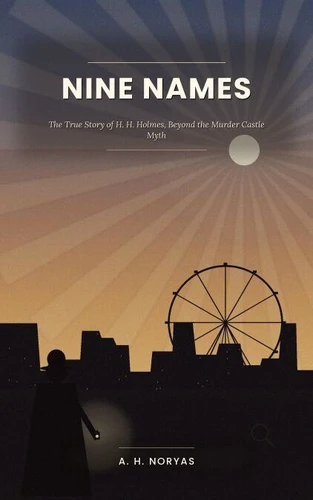
H. H. Holmes is remembered as America's first serial killer - the architect of a three-story "Murder Castle" in Chicago, fitted with gas chambers and torture racks, where he allegedly killed as many as two hundred people during the 1893 World's Fair. Almost none of that is true. Drawing on trial transcripts, Detective Frank Geyer's own 1896 investigative account, and a decade of rigorous archival correction by modern historians, NINE NAMES tells the story of what H.
H. Holmes actually did - and how a killer who murdered at least nine people, several of them children, for cold and specific financial gain became, across more than a century of newspapers, pulp fiction, and bestselling narrative nonfiction, something considerably larger and more theatrical than the documented record has ever actually supported. This book follows the real case: the insurance fraud that began in medical school, the pharmacy purchased from a woman who was never murdered, the "secret passages" that turned out to hide furniture bought on credit rather than victims, and the single Philadelphia detective whose patient, unglamorous work - recovering three children's remains across two countries - actually solved it.
It follows, too, how a 1940 pulp history book invented the two-hundred-victim myth virtually out of nothing, and how that invention has outrun the truth in nearly every retelling since. Most of all, this book follows nine people: Julia and Pearl Conner. Emeline Cigrand. Minnie and Anna Williams. Benjamin, Alice, Nellie, and Howard Pitezel. Real victims, given real weight - not anonymous entries in an inflated body count, but the actual, irreplaceable center of a story that has spent a century being told without them.


 , qui est-ce ?