
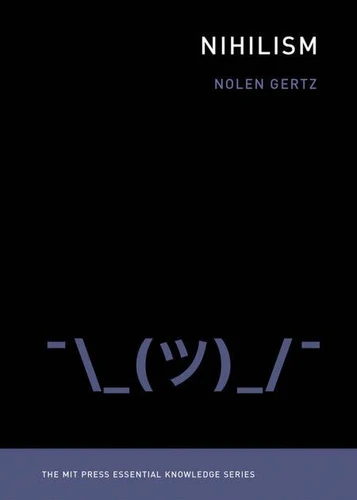
Nihilism
Par :Formats :
Disponible dans votre compte client Decitre ou Furet du Nord dès validation de votre commande. Le format ePub protégé est :
- Compatible avec une lecture sur My Vivlio (smartphone, tablette, ordinateur)
- Compatible avec une lecture sur liseuses Vivlio
- Pour les liseuses autres que Vivlio, vous devez utiliser le logiciel Adobe Digital Edition. Non compatible avec la lecture sur les liseuses Kindle, Remarkable et Sony
- Non compatible avec un achat hors France métropolitaine
 , qui est-ce ?
Notre partenaire de plateforme de lecture numérique où vous retrouverez l'ensemble de vos ebooks gratuitement
Pour en savoir plus sur nos ebooks, consultez notre aide en ligne ici
C'est si simple ! Lisez votre ebook avec l'app Vivlio sur votre tablette, mobile ou ordinateur :

- Nombre de pages224
- FormatePub
- ISBN978-0-262-35333-5
- EAN9780262353335
- Date de parution10/09/2019
- Protection num.Adobe DRM
- Taille147 Ko
- Infos supplémentairesepub
- ÉditeurThe MIT Press
Résumé
An examination of the meaning of meaninglessness: why it matters that nothing matters. When someone is labeled a nihilist, it's not usually meant as a compliment. Most of us associate nihilism with destructiveness and violence. Nihilism means, literally, "an ideology of nothing. " Is nihilism, then, believing in nothing? Or is it the belief that life is nothing? Or the belief that the beliefs we have amount to nothing? If we can learn to recognize the many varieties of nihilism, Nolen Gertz writes, then we can learn to distinguish what is meaningful from what is meaningless.
In this addition to the MIT Press Essential Knowledge series, Gertz traces the history of nihilism in Western philosophy from Socrates through Hannah Arendt and Jean-Paul Sartre. Although the term "nihilism" was first used by Friedrich Jacobi to criticize the philosophy of Immanuel Kant, Gertz shows that the concept can illuminate the thinking of Socrates, Descartes, and others. It is Nietzsche, however, who is most associated with nihilism, and Gertz focuses on Nietzsche's thought.
Gertz goes on to consider what is not nihilism-pessimism, cynicism, and apathy-and why; he explores theories of nihilism, including those associated with Existentialism and Postmodernism; he considers nihilism as a way of understanding aspects of everyday life, calling on Adorno, Arendt, Marx, and prestige television, among other sources; and he reflects on the future of nihilism. We need to understand nihilism not only from an individual perspective, Gertz tells us, but also from a political one.
In this addition to the MIT Press Essential Knowledge series, Gertz traces the history of nihilism in Western philosophy from Socrates through Hannah Arendt and Jean-Paul Sartre. Although the term "nihilism" was first used by Friedrich Jacobi to criticize the philosophy of Immanuel Kant, Gertz shows that the concept can illuminate the thinking of Socrates, Descartes, and others. It is Nietzsche, however, who is most associated with nihilism, and Gertz focuses on Nietzsche's thought.
Gertz goes on to consider what is not nihilism-pessimism, cynicism, and apathy-and why; he explores theories of nihilism, including those associated with Existentialism and Postmodernism; he considers nihilism as a way of understanding aspects of everyday life, calling on Adorno, Arendt, Marx, and prestige television, among other sources; and he reflects on the future of nihilism. We need to understand nihilism not only from an individual perspective, Gertz tells us, but also from a political one.