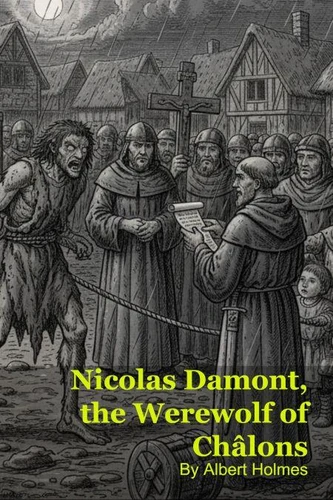
Nicolas Damont, the Werewolf of ChâlonsIn 1598, a respected master tailor in Châlons, France, was executed as a werewolf for murdering and consuming children. Authorities deliberately destroyed all court records following his execution, creating an enduring historical mystery that transcends mere documentation gaps. This historical investigation explores how Damont's case illuminates the collision between criminal law and theological frameworks in Early Modern Europe.
As a trusted professional exploiting his position to commit atrocities, the "Demon Tailor" represents an archetypal figure whose parallels extend from historical werewolf trials to modern serial killers. The book examines the methodological challenges of researching deliberately fragmented evidence, the transition of Damont from historical figure to folkloric entity, and why his case continues to resonate despite-or perhaps because of-its deliberate obscurity.
Damont's transformation from human to werewolf through judicial process parallels the evolution of explanatory frameworks from supernatural to psychological, revealing surprising continuities in how societies process extreme manifestations of human depravity. Ultimately, Damont's case demonstrates how certain historical episodes maintain cultural significance through their very ambiguity, raising enduring questions about human nature, professional trust violation, and the boundaries between human and monstrous that remain relevant four centuries later.
The werewolf's howl still echoes, reminding us that some mysteries of human darkness persist despite our evolving frameworks for understanding them.
Nicolas Damont, the Werewolf of ChâlonsIn 1598, a respected master tailor in Châlons, France, was executed as a werewolf for murdering and consuming children. Authorities deliberately destroyed all court records following his execution, creating an enduring historical mystery that transcends mere documentation gaps. This historical investigation explores how Damont's case illuminates the collision between criminal law and theological frameworks in Early Modern Europe.
As a trusted professional exploiting his position to commit atrocities, the "Demon Tailor" represents an archetypal figure whose parallels extend from historical werewolf trials to modern serial killers. The book examines the methodological challenges of researching deliberately fragmented evidence, the transition of Damont from historical figure to folkloric entity, and why his case continues to resonate despite-or perhaps because of-its deliberate obscurity.
Damont's transformation from human to werewolf through judicial process parallels the evolution of explanatory frameworks from supernatural to psychological, revealing surprising continuities in how societies process extreme manifestations of human depravity. Ultimately, Damont's case demonstrates how certain historical episodes maintain cultural significance through their very ambiguity, raising enduring questions about human nature, professional trust violation, and the boundaries between human and monstrous that remain relevant four centuries later.
The werewolf's howl still echoes, reminding us that some mysteries of human darkness persist despite our evolving frameworks for understanding them.

 , qui est-ce ?