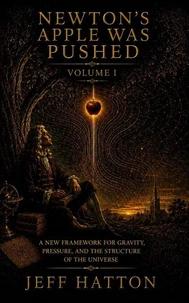
Newton's Apple Was Pushed. Newton's Apple Was Pushed, #3
Par :Formats :
Disponible dans votre compte client Decitre ou Furet du Nord dès validation de votre commande. Le format ePub est :
- Compatible avec une lecture sur My Vivlio (smartphone, tablette, ordinateur)
- Compatible avec une lecture sur liseuses Vivlio
- Pour les liseuses autres que Vivlio, vous devez utiliser le logiciel Adobe Digital Edition. Non compatible avec la lecture sur les liseuses Kindle, Remarkable et Sony
 , qui est-ce ?
Notre partenaire de plateforme de lecture numérique où vous retrouverez l'ensemble de vos ebooks gratuitement
Pour en savoir plus sur nos ebooks, consultez notre aide en ligne ici
C'est si simple ! Lisez votre ebook avec l'app Vivlio sur votre tablette, mobile ou ordinateur :

- FormatePub
- ISBN8235987111
- EAN9798235987111
- Date de parution19/05/2026
- Protection num.pas de protection
- Infos supplémentairesepub
- ÉditeurIoakim Ioakim
Résumé
Newton's Apple Was Pushed: Dynamic Physics, Energy, and the Compression Medium continues the exploratory framework introduced in the first two volumes of the series. Beginning from the central inversion proposed in Book One-that the singularity associated with a black hole may correspond not to a point, but to the entire interior-this third volume pushes the compression-medium ontology into more dynamic and energetic regimes.
Earlier volumes explored how gravity might emerge from pressure behavior within an underlying medium and developed a scalar toy model capable of reproducing a range of weak-field gravitational phenomena. Book Three extends that investigation into questions involving wave propagation, energy transport, organized field structure, radiation-like behavior, nonlinear interaction, and the emergence of large-scale physical organization.
Rather than treating the framework as a finished theory, this book approaches it as a conceptual laboratory: a structured attempt to examine what kinds of physical behavior become possible when gravity, mass, inertia, and energy are interpreted through the dynamics of a compression-based medium. The scalar model explored here remains approximate and incomplete, and its limitations are addressed directly throughout the text, including questions involving tensor structure, relativistic consistency, and the boundaries of scalar descriptions.
A major theme running throughout the book is the transition from static gravitational interpretation toward dynamic physical behavior. Instead of focusing only on weak-field gravitational effects, the discussion expands into evolving field structure, propagation behavior, momentum, inertia, energy redistribution, and organized large-scale patterns within the medium itself. The investigation progresses from foundational assumptions through energy, propagation, inertia, field organization, and scalar limitations before arriving at questions involving emergent geometry and deeper medium structure.
One of the most important developments emerging from this exploration is a shift in perspective regarding geometry itself. While earlier stages of the framework investigated whether the model could move toward General Relativity-like behavior in certain limits, deeper analysis increasingly suggests a different possibility: that geometric behavior may be emergent rather than fundamental. The result is not a claim to have solved gravity or replaced modern physics.
Instead, this volume presents a disciplined exploratory investigation into what a pressure-based ontology may imply when developed mathematically and interpreted carefully. Topics explored throughout the book include:. Dynamic propagation in the compression field. Energy localization and redistribution. Radiation-like behavior and wave transport. Momentum and the emergence of inertia. Organized structure and stability.
Emergent geometry and spacetime interpretation. Scalar limitations and tensor structure. Weak-field approximation behavior. Nonlinear interaction within the medium. Collective organization and large-scale structureWritten for curious readers, independent thinkers, and technically inclined audiences interested in foundational physics, cosmology, gravity, emergence, and the philosophy of science, this volume continues the trilogy's central question:What if gravity is not a force acting across empty space, but the organized behavior of a deeper medium whose large-scale structure only appears geometric from within?
Earlier volumes explored how gravity might emerge from pressure behavior within an underlying medium and developed a scalar toy model capable of reproducing a range of weak-field gravitational phenomena. Book Three extends that investigation into questions involving wave propagation, energy transport, organized field structure, radiation-like behavior, nonlinear interaction, and the emergence of large-scale physical organization.
Rather than treating the framework as a finished theory, this book approaches it as a conceptual laboratory: a structured attempt to examine what kinds of physical behavior become possible when gravity, mass, inertia, and energy are interpreted through the dynamics of a compression-based medium. The scalar model explored here remains approximate and incomplete, and its limitations are addressed directly throughout the text, including questions involving tensor structure, relativistic consistency, and the boundaries of scalar descriptions.
A major theme running throughout the book is the transition from static gravitational interpretation toward dynamic physical behavior. Instead of focusing only on weak-field gravitational effects, the discussion expands into evolving field structure, propagation behavior, momentum, inertia, energy redistribution, and organized large-scale patterns within the medium itself. The investigation progresses from foundational assumptions through energy, propagation, inertia, field organization, and scalar limitations before arriving at questions involving emergent geometry and deeper medium structure.
One of the most important developments emerging from this exploration is a shift in perspective regarding geometry itself. While earlier stages of the framework investigated whether the model could move toward General Relativity-like behavior in certain limits, deeper analysis increasingly suggests a different possibility: that geometric behavior may be emergent rather than fundamental. The result is not a claim to have solved gravity or replaced modern physics.
Instead, this volume presents a disciplined exploratory investigation into what a pressure-based ontology may imply when developed mathematically and interpreted carefully. Topics explored throughout the book include:. Dynamic propagation in the compression field. Energy localization and redistribution. Radiation-like behavior and wave transport. Momentum and the emergence of inertia. Organized structure and stability.
Emergent geometry and spacetime interpretation. Scalar limitations and tensor structure. Weak-field approximation behavior. Nonlinear interaction within the medium. Collective organization and large-scale structureWritten for curious readers, independent thinkers, and technically inclined audiences interested in foundational physics, cosmology, gravity, emergence, and the philosophy of science, this volume continues the trilogy's central question:What if gravity is not a force acting across empty space, but the organized behavior of a deeper medium whose large-scale structure only appears geometric from within?