
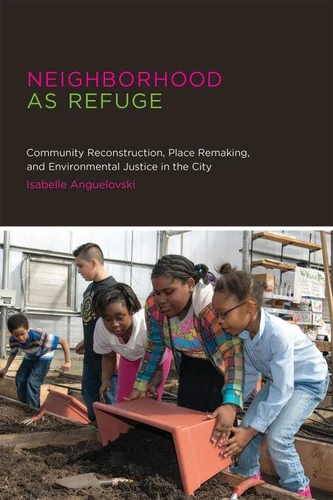
Neighborhood as Refuge. Community Reconstruction, Place Remaking, and Environmental Justice in the City
Par :Formats :
Disponible dans votre compte client Decitre ou Furet du Nord dès validation de votre commande. Le format ePub protégé est :
- Compatible avec une lecture sur My Vivlio (smartphone, tablette, ordinateur)
- Compatible avec une lecture sur liseuses Vivlio
- Pour les liseuses autres que Vivlio, vous devez utiliser le logiciel Adobe Digital Edition. Non compatible avec la lecture sur les liseuses Kindle, Remarkable et Sony
- Non compatible avec un achat hors France métropolitaine
 , qui est-ce ?
Notre partenaire de plateforme de lecture numérique où vous retrouverez l'ensemble de vos ebooks gratuitement
Pour en savoir plus sur nos ebooks, consultez notre aide en ligne ici
C'est si simple ! Lisez votre ebook avec l'app Vivlio sur votre tablette, mobile ou ordinateur :

- Nombre de pages296
- FormatePub
- ISBN978-0-262-32219-5
- EAN9780262322195
- Date de parution21/03/2014
- Protection num.Adobe DRM
- Taille6 Mo
- Infos supplémentairesepub
- ÉditeurThe MIT Press
Résumé
An examination of environmental revitalization efforts in low-income communities in Boston, Barcelona, and Havana that help heal traumatized urban neighborhoods. Environmental justice as studied in a variety of disciplines is most often associated with redressing disproportionate exposure to pollution, contamination, and toxic sites. In Neighborhood as Refuge, Isabelle Anguelovski takes a broader view of environmental justice, examining wide-ranging comprehensive efforts at neighborhood environmental revitalization that include parks, urban agriculture, fresh food markets, playgrounds, housing, and waste management.
She investigates and compares three minority, low-income neighborhoods that organized to improve environmental quality and livability: Casc Antic, in Barcelona; Dudley, in the Roxbury section of Boston; and Cayo Hueso, in Havana. Despite the differing histories and political contexts of these three communities, Anguelovski finds similar patterns of activism. She shows that behind successful revitalization efforts is what she calls "bottom to bottom" networking, powered by broad coalitions of residents, community organizations, architects, artists, funders, political leaders, and at times environmental advocacy groups.
Anguelovski also describes how, over time, environmental projects provide psychological benefits, serving as a way to heal a marginalized and environmentally traumatized urban neighborhood. They encourage a sense of rootedness and of attachment to place, creating safe havens that offer residents a space for recovery. They also help to bolster residents' ability to deal with the negative dynamics of discrimination and provide spaces for broader political struggles including gentrification.
Drawing on the cases of Barcelona, Boston, and Havana, Anguelovski presents a new holistic framework for understanding environmental justice action in cities, with the right to a healthy community environment at its core.
She investigates and compares three minority, low-income neighborhoods that organized to improve environmental quality and livability: Casc Antic, in Barcelona; Dudley, in the Roxbury section of Boston; and Cayo Hueso, in Havana. Despite the differing histories and political contexts of these three communities, Anguelovski finds similar patterns of activism. She shows that behind successful revitalization efforts is what she calls "bottom to bottom" networking, powered by broad coalitions of residents, community organizations, architects, artists, funders, political leaders, and at times environmental advocacy groups.
Anguelovski also describes how, over time, environmental projects provide psychological benefits, serving as a way to heal a marginalized and environmentally traumatized urban neighborhood. They encourage a sense of rootedness and of attachment to place, creating safe havens that offer residents a space for recovery. They also help to bolster residents' ability to deal with the negative dynamics of discrimination and provide spaces for broader political struggles including gentrification.
Drawing on the cases of Barcelona, Boston, and Havana, Anguelovski presents a new holistic framework for understanding environmental justice action in cities, with the right to a healthy community environment at its core.