
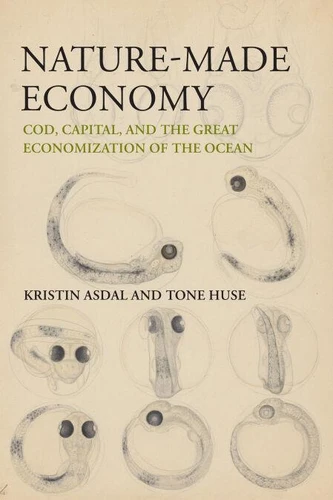
Nature-Made Economy. Cod, Capital, and the Great Economization of the Ocean
Par : ,Formats :
Disponible dans votre compte client Decitre ou Furet du Nord dès validation de votre commande. Le format ePub protégé est :
- Compatible avec une lecture sur My Vivlio (smartphone, tablette, ordinateur)
- Compatible avec une lecture sur liseuses Vivlio
- Pour les liseuses autres que Vivlio, vous devez utiliser le logiciel Adobe Digital Edition. Non compatible avec la lecture sur les liseuses Kindle, Remarkable et Sony
- Non compatible avec un achat hors France métropolitaine
 , qui est-ce ?
Notre partenaire de plateforme de lecture numérique où vous retrouverez l'ensemble de vos ebooks gratuitement
Pour en savoir plus sur nos ebooks, consultez notre aide en ligne ici
C'est si simple ! Lisez votre ebook avec l'app Vivlio sur votre tablette, mobile ou ordinateur :

- Nombre de pages280
- FormatePub
- ISBN978-0-262-37441-5
- EAN9780262374415
- Date de parution17/10/2023
- Protection num.Adobe DRM
- Taille3 Mo
- Infos supplémentairesepub
- ÉditeurThe MIT Press
Résumé
An exploration of the economization of the ocean through the small modifications that enable great transformations of nature. The ocean is the site of an ongoing transformation that is aimed at creating new economic opportunities and prosperity. In Nature-Made Economy, Kristin Asdal and Tone Huse explore how the ocean has been harnessed to become a space of capital investment and innovation, and how living nature is wrested into the economy even as nature, in turn, resists, adapts to, or changes the economy.
The authors' innovative methodological and conceptual approaches examine the economy by focusing on surprising and numerous "little tools"-such as maps and policy documents, quality patrols, and dietary requirements for the enhancement of species' biological propensities-that value, direct, reorder, accomplish, and sometimes fail to serve our ends, but also add up to great change. Throughout Nature-Made Economy, Asdal and Huse follow one species, the Atlantic cod, and explore how it is subjected to different versions of economization.
Taking this species as a point of departure, they then provide novel analyses of the innovation economy, the architecture of markets, the settling of prices, and more, revealing how the ocean is rendered a space of intense economic exploitation. Through their analysis, the authors develop a distinct theoretical approach and conceptual vocabulary for studying nature-economy relations. Nature-Made Economy is a significant contribution to the broad field of STS and social studies of markets, as well as to studies of the Anthropocene, the environment, and human-animal relations.
The authors' innovative methodological and conceptual approaches examine the economy by focusing on surprising and numerous "little tools"-such as maps and policy documents, quality patrols, and dietary requirements for the enhancement of species' biological propensities-that value, direct, reorder, accomplish, and sometimes fail to serve our ends, but also add up to great change. Throughout Nature-Made Economy, Asdal and Huse follow one species, the Atlantic cod, and explore how it is subjected to different versions of economization.
Taking this species as a point of departure, they then provide novel analyses of the innovation economy, the architecture of markets, the settling of prices, and more, revealing how the ocean is rendered a space of intense economic exploitation. Through their analysis, the authors develop a distinct theoretical approach and conceptual vocabulary for studying nature-economy relations. Nature-Made Economy is a significant contribution to the broad field of STS and social studies of markets, as well as to studies of the Anthropocene, the environment, and human-animal relations.