Known for psychology and behavioral analysis books that combine research, philosophy, and practical decision-making frameworks.
Nouveauté
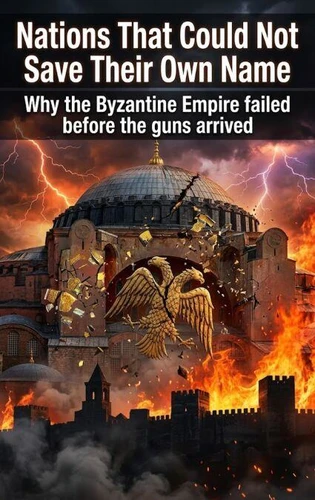
Nations That Could Not Save Their Own Name. Why the Byzantine Empire failed before the guns arrived
Par :Formats :
Disponible dans votre compte client Decitre ou Furet du Nord dès validation de votre commande. Le format ePub est :
- Compatible avec une lecture sur My Vivlio (smartphone, tablette, ordinateur)
- Compatible avec une lecture sur liseuses Vivlio
- Pour les liseuses autres que Vivlio, vous devez utiliser le logiciel Adobe Digital Edition. Non compatible avec la lecture sur les liseuses Kindle, Remarkable et Sony
 , qui est-ce ?
Notre partenaire de plateforme de lecture numérique où vous retrouverez l'ensemble de vos ebooks gratuitement
Pour en savoir plus sur nos ebooks, consultez notre aide en ligne ici
C'est si simple ! Lisez votre ebook avec l'app Vivlio sur votre tablette, mobile ou ordinateur :

- Nombre de pages174
- FormatePub
- ISBN978-3-565-55220-7
- EAN9783565552207
- Date de parution09/07/2026
- Protection num.pas de protection
- Taille546 Ko
- Infos supplémentairesepub
- ÉditeurEmphaloz Publishing House
Résumé
Long before the Ottoman cannons were positioned before the Theodosian Walls, the Byzantine Empire had already begun to die from the inside. This book argues that the fall of Constantinople in 1453 was less a military defeat than the final symptom of a political organism that had lost the capacity to sustain itself. The empire that once stretched from Spain to Syria had been reduced to a city-state, its treasury empty, its army composed of foreign mercenaries, its church divided by the failed union with Rome.
The narrative traces the fourteenth-century civil wars that exhausted Byzantine resources, the catastrophic reliance on Venetian and Genoese shipping, and the diplomatic isolation that left Constantinople without allies when Mehmed II finally moved. It examines how the Palaiologos dynasty, despite producing capable individuals, could never transcend the structural decay of a bureaucracy that collected taxes from fields it no longer controlled and minted coins of increasingly worthless metal.
The siege itself becomes a mirror of this collapse: the defenders fought bravely but could not compensate for a state that had stopped believing in its own future. This is not a story of heroic last stands but of institutional sclerosis, of a government that had perfected the art of postponing collapse until collapse became the only remaining option.
The narrative traces the fourteenth-century civil wars that exhausted Byzantine resources, the catastrophic reliance on Venetian and Genoese shipping, and the diplomatic isolation that left Constantinople without allies when Mehmed II finally moved. It examines how the Palaiologos dynasty, despite producing capable individuals, could never transcend the structural decay of a bureaucracy that collected taxes from fields it no longer controlled and minted coins of increasingly worthless metal.
The siege itself becomes a mirror of this collapse: the defenders fought bravely but could not compensate for a state that had stopped believing in its own future. This is not a story of heroic last stands but of institutional sclerosis, of a government that had perfected the art of postponing collapse until collapse became the only remaining option.