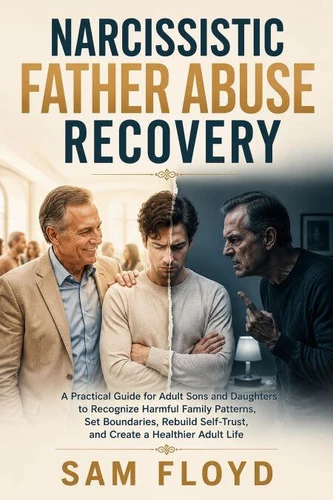
Growing up with a narcissistic, controlling, critical, or emotionally harmful father can affect far more than your childhood. The patterns can follow you into adulthood through self-doubt, guilt, people-pleasing, difficulty setting boundaries, fear of conflict, unhealthy family roles, and relationships that repeat familiar dynamics. Narcissistic Father Abuse Recovery gives adult sons and daughters a clear, grounded path toward understanding what happened and deciding what comes next.
Rather than requiring you to diagnose your father, this book helps you focus on observable behavior, repeated patterns, their impact on your adult life, and the choices that remain within your control. Inside, you will learn how to:. Recognize narcissistic traits and repeated harmful family behavior without relying on unsupported diagnoses. Understand how control, conditional approval, guilt, financial pressure, privacy violations, and reputation management operate within families.
Identify family roles, triangulation, favoritism, sibling conflict, and enabling behavior. Rebuild confidence in your own judgment after years of criticism and second-guessing. Set boundaries around your time, privacy, money, home, relationships, and personal decisions. Respond more effectively to guilt, gaslighting, anger, accusations, and emotional pressure. Decide whether full, structured, limited, written-only, or no direct contact best fits your circumstances.
Protect children from adult family conflict and create clearer communication and documentation. Reduce people-pleasing, excessive explanations, reassurance seeking, and approval dependence. Build healthier adult relationships based on mutual respect, privacy, accountability, and emotional safety. Strengthen your identity, emotional stability, and self-trust. Create a realistic recovery plan that supports the life you want to buildRecovery does not require rewriting your entire history or waiting for your father to acknowledge what happened.
You can begin by changing how you respond, what access you allow, whose approval guides your decisions, and how much of your present life remains controlled by old family patterns. Narcissistic Father Abuse Recovery provides practical guidance for moving from confusion and repeated family pressure toward clearer boundaries, stronger self-trust, healthier relationships, and greater confidence in your adult choices.
Growing up with a narcissistic, controlling, critical, or emotionally harmful father can affect far more than your childhood. The patterns can follow you into adulthood through self-doubt, guilt, people-pleasing, difficulty setting boundaries, fear of conflict, unhealthy family roles, and relationships that repeat familiar dynamics. Narcissistic Father Abuse Recovery gives adult sons and daughters a clear, grounded path toward understanding what happened and deciding what comes next.
Rather than requiring you to diagnose your father, this book helps you focus on observable behavior, repeated patterns, their impact on your adult life, and the choices that remain within your control. Inside, you will learn how to:. Recognize narcissistic traits and repeated harmful family behavior without relying on unsupported diagnoses. Understand how control, conditional approval, guilt, financial pressure, privacy violations, and reputation management operate within families.
Identify family roles, triangulation, favoritism, sibling conflict, and enabling behavior. Rebuild confidence in your own judgment after years of criticism and second-guessing. Set boundaries around your time, privacy, money, home, relationships, and personal decisions. Respond more effectively to guilt, gaslighting, anger, accusations, and emotional pressure. Decide whether full, structured, limited, written-only, or no direct contact best fits your circumstances.
Protect children from adult family conflict and create clearer communication and documentation. Reduce people-pleasing, excessive explanations, reassurance seeking, and approval dependence. Build healthier adult relationships based on mutual respect, privacy, accountability, and emotional safety. Strengthen your identity, emotional stability, and self-trust. Create a realistic recovery plan that supports the life you want to buildRecovery does not require rewriting your entire history or waiting for your father to acknowledge what happened.
You can begin by changing how you respond, what access you allow, whose approval guides your decisions, and how much of your present life remains controlled by old family patterns. Narcissistic Father Abuse Recovery provides practical guidance for moving from confusion and repeated family pressure toward clearer boundaries, stronger self-trust, healthier relationships, and greater confidence in your adult choices.

 , qui est-ce ?