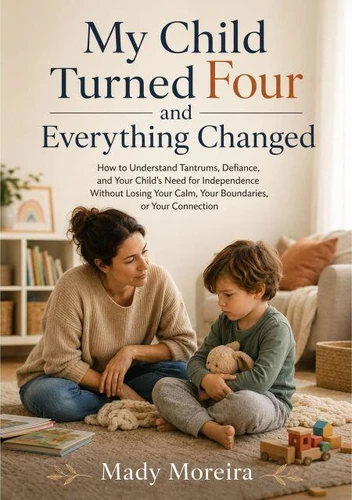
What happened to my child?If your four-year-old suddenly says "no" to almost everything, turns simple routines into battles, cries over limits, refuses to cooperate, hits, runs away, or seems overwhelmed by emotions that appear from nowhere, you are not alone. Many children around this age seem bigger, more verbal, and more independent - but their ability to wait, accept frustration, manage transitions, control impulses, and recover from disappointment is still developing.
This practical guide helps mothers understand what may be happening beneath tantrums, defiance, resistance, and emotional outbursts, without excusing unsafe behaviour or turning every conflict into a power struggle. Inside, you will learn how to:. understand why behaviour can change so intensely around age four;. tell the difference between tantrums, refusal, overload, tiredness, frustration, and a real need for help;.
prepare difficult transitions such as leaving the park, turning off screens, bath time, bedtime, and getting out of the house;. set clear boundaries without shouting, threatening, humiliating, or giving in from exhaustion;. respond when your child says "I don't want to" again and again;. handle hitting, throwing, running away, public tantrums, and sibling conflicts with more safety and less panic;.
know what to do after the storm, when your child is finally able to reconnect and learn;. teach simple words your child can use instead of screaming, hitting, or throwing;. repair after conflict without forcing empty apologies, shame, hugs, or kisses;. recognise your own breaking point as a mother and respond before you explode;. deal with situations where other adults disagree, undermine limits, or leave all the responsibility to you;.
identify real progress, even when tantrums have not disappeared completely;. understand when intensity, frequency, aggression, loss of skills, or family exhaustion may justify professional guidance. This is not a book that promises to end every tantrum. It is not a rigid discipline system based on fear or punishment. It is a realistic, compassionate, and practical guide for mothers who want to be firm and loving at the same time.
Because your child does not need a perfect mother. Your child needs an adult who can protect, guide, repair, and return. With clear examples, practical phrases, a seven-day plan, quick-reference guidance, and printable worksheets, this book helps you stop reacting in the dark and begin responding with more clarity, confidence, and connection. Start with one moment. One boundary. One sentence. One repair.
One next step.
What happened to my child?If your four-year-old suddenly says "no" to almost everything, turns simple routines into battles, cries over limits, refuses to cooperate, hits, runs away, or seems overwhelmed by emotions that appear from nowhere, you are not alone. Many children around this age seem bigger, more verbal, and more independent - but their ability to wait, accept frustration, manage transitions, control impulses, and recover from disappointment is still developing.
This practical guide helps mothers understand what may be happening beneath tantrums, defiance, resistance, and emotional outbursts, without excusing unsafe behaviour or turning every conflict into a power struggle. Inside, you will learn how to:. understand why behaviour can change so intensely around age four;. tell the difference between tantrums, refusal, overload, tiredness, frustration, and a real need for help;.
prepare difficult transitions such as leaving the park, turning off screens, bath time, bedtime, and getting out of the house;. set clear boundaries without shouting, threatening, humiliating, or giving in from exhaustion;. respond when your child says "I don't want to" again and again;. handle hitting, throwing, running away, public tantrums, and sibling conflicts with more safety and less panic;.
know what to do after the storm, when your child is finally able to reconnect and learn;. teach simple words your child can use instead of screaming, hitting, or throwing;. repair after conflict without forcing empty apologies, shame, hugs, or kisses;. recognise your own breaking point as a mother and respond before you explode;. deal with situations where other adults disagree, undermine limits, or leave all the responsibility to you;.
identify real progress, even when tantrums have not disappeared completely;. understand when intensity, frequency, aggression, loss of skills, or family exhaustion may justify professional guidance. This is not a book that promises to end every tantrum. It is not a rigid discipline system based on fear or punishment. It is a realistic, compassionate, and practical guide for mothers who want to be firm and loving at the same time.
Because your child does not need a perfect mother. Your child needs an adult who can protect, guide, repair, and return. With clear examples, practical phrases, a seven-day plan, quick-reference guidance, and printable worksheets, this book helps you stop reacting in the dark and begin responding with more clarity, confidence, and connection. Start with one moment. One boundary. One sentence. One repair.
One next step.