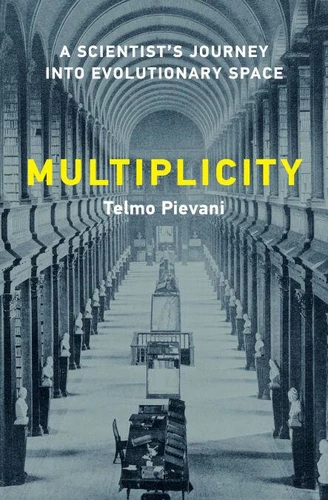
Multiplicity. A Scientist’s Journey into Evolutionary Space
Par :Formats :
Disponible dans votre compte client Decitre ou Furet du Nord dès validation de votre commande. Le format ePub protégé est :
- Compatible avec une lecture sur My Vivlio (smartphone, tablette, ordinateur)
- Compatible avec une lecture sur liseuses Vivlio
- Pour les liseuses autres que Vivlio, vous devez utiliser le logiciel Adobe Digital Edition. Non compatible avec la lecture sur les liseuses Kindle, Remarkable et Sony
- Non compatible avec un achat hors France métropolitaine
 , qui est-ce ?
Notre partenaire de plateforme de lecture numérique où vous retrouverez l'ensemble de vos ebooks gratuitement
Pour en savoir plus sur nos ebooks, consultez notre aide en ligne ici
C'est si simple ! Lisez votre ebook avec l'app Vivlio sur votre tablette, mobile ou ordinateur :

- Nombre de pages184
- Date de parution06/10/2026
- FormatePub
- ISBN978-0-262-05498-0
- EAN9780262054980
- Protection num.Adobe DRM
- Taille1 Mo
- Infos supplémentairesepub
- ÉditeurThe MIT Press
Résumé
The awe-inspiring, little-known story of Nobel laureate Frances Arnold's discovery of directed enzyme evolution-and how it was sparked by reading Jorge Luis Borges. In 1976, a young engineering student from Princeton, Frances Arnold, happened upon Jorge Luis Borges's short story "The Library of Babel" while in Madrid. The tale recounts a vast honeycomb of a library that contains all the answers to the mysteries of humanity.
Little did Arnold know that the story would change the course of her life-and the course of science. In Multiplicity, Telmo Pievani explores her journey and the significance-and scientific potential-of Borges's legendary library and others like it. The famous evolutionist John Maynard Smith, for instance, had fantasized about the existence of a similar enormous library full of proteins rather than books.
And in 1995 the philosopher of mind Daniel Dennett would devise a library no less confounding: one that collects all possible genomes, or all possible combinations of the nucleotide bases of DNA. Why? Because by comparing all the proteins, genomes, and plants and animals that exist and have existed throughout evolution, what is finally revealed is possibility-what doesn't exist but could. For Arnold, the concept of such a library ultimately led to the discovery of the directed evolution of enzymes: a way of using nature's own method to produce new and better enzymes.
The revolutionary idea transformed protein chemistry and biotechnology and earned her the Nobel Prize in Chemistry in 2018. With literary echoes ranging from Borges to Italo Calvino, this slim book tells her brilliant story.
Little did Arnold know that the story would change the course of her life-and the course of science. In Multiplicity, Telmo Pievani explores her journey and the significance-and scientific potential-of Borges's legendary library and others like it. The famous evolutionist John Maynard Smith, for instance, had fantasized about the existence of a similar enormous library full of proteins rather than books.
And in 1995 the philosopher of mind Daniel Dennett would devise a library no less confounding: one that collects all possible genomes, or all possible combinations of the nucleotide bases of DNA. Why? Because by comparing all the proteins, genomes, and plants and animals that exist and have existed throughout evolution, what is finally revealed is possibility-what doesn't exist but could. For Arnold, the concept of such a library ultimately led to the discovery of the directed evolution of enzymes: a way of using nature's own method to produce new and better enzymes.
The revolutionary idea transformed protein chemistry and biotechnology and earned her the Nobel Prize in Chemistry in 2018. With literary echoes ranging from Borges to Italo Calvino, this slim book tells her brilliant story.